
Pink-footed goose
Anser brachyrhynchus
Description
How to identify
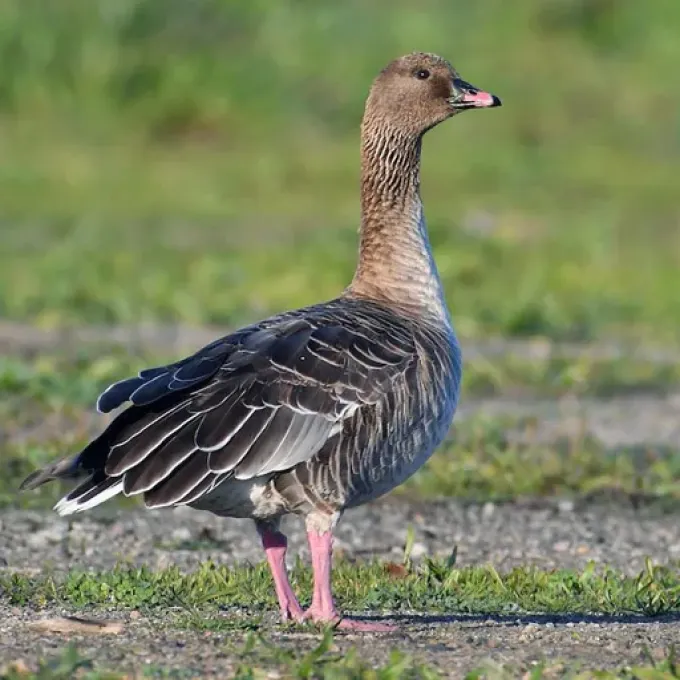
The pink-footed goose (Anser brachyrhynchus) is a migratory waterfowl belonging to the Anatidae family. It is a medium-sized goose with a distinct black bill featuring a pinkish band and dark-brown head and neck feathers.
The bird has a compact appearance with relatively short pink legs, which makes it easy to identify in agricultural fields. Its brownish-grey wings are a key feature observed during flight when the birds arrive at their grazing sites.
While their primary breeding grounds are in the Arctic, they have significantly expanded their wintering and stopover habitats into intensively cultivated areas in Europe. This adaptation has turned them into a significant concern for modern agronomy.
These geese are highly social and gregarious, often gathering in large flocks. Their biology is well-suited to open fields, allowing them to exploit vast areas of farmland effectively during their migratory journeys.
Their life cycle revolves around seasonal migration, and they exhibit strong fidelity to specific feeding sites. Once a flock identifies a productive field, they are likely to return repeatedly, which increases the cumulative pressure on the crops.
##damage##Pink-footed geese are known for causing considerable damage to winter cereals, including wheat, barley, and rye. During the spring, they feed on young shoots, which can severely reduce plant density across large agricultural sections.
In addition to cereals, they may target sugar beet crops, consuming young seedlings and trampling the fields. They also forage on post-harvest fields, clearing leftover residues like potatoes or vegetable scraps, which disrupts normal field management practices.
The most severe damage occurs when geese pull the plants out by the roots, which prevents the crop from regrowing. This often forces farmers to invest in costly reseeding operations to replace the damaged areas.
The physical presence of large flocks leads to soil compaction, especially in damp conditions, which hampers root development and aeration. Even without complete crop destruction, the stunted growth of the plants significantly lowers total yield.
They also pose a threat to livestock production by overgrazing pastures and hay meadows. By consuming the most nutritious grasses, they diminish the available grazing resources for farm animals during the early growing season.
##season##The highest level of activity and damage occurs during spring migration, primarily in March and April. At this stage, young winter crops are tender and highly attractive to the birds, who are hungry after their long journey from wintering grounds.
The autumn migration, spanning from September to November, brings geese back to stubble fields and late-sown winter crops. They use these fields to replenish fat reserves needed for their upcoming long-distance flights.
In regions with milder winters, these birds may stay longer, creating a persistent pressure on winter crops. This extended presence can lead to continuous grazing, preventing the crops from establishing a healthy canopy.
The daily rhythm of the geese typically involves feeding sessions at dawn and dusk. Understanding this behavior allows agronomists to focus their deterrent efforts during these peak feeding hours to achieve maximum efficiency.
Climate change is shifting migration patterns, often leading to earlier arrivals and longer stopovers. Early spring thaws are particularly critical, as they provide earlier access to fields that would otherwise be protected by snow or ice.
##signs##A primary indicator of pink-footed goose presence is the accumulation of droppings across the field. High density of fecal matter is a clear sign that a flock has spent a significant amount of time grazing in the area.
Characteristic signs of damage include patches of the field that appear neatly mown. In these areas, the crop is stripped to the ground, and clear footprints can be seen in the soil, especially in soft or moist conditions.
Surrounding the stripped patches, one can often find uprooted plants that were partially consumed. This sloppy feeding behavior is typical of geese, which pull up more vegetation than they can ingest at once.
Audible signals, such as the constant honking of a flock, serve as a reliable alert for monitoring efforts. The noise is quite distinctive and typically intensifies during the active feeding hours in the morning and evening.
The presence of shed feathers along the edges of the fields or near local ponds is a strong indicator of a flock's location. Regular checks near water bodies that border cropland are essential for early detection.
##control##Propane cannons and other acoustic deterrents are widely used to scare off geese from high-value crops. To prevent the birds from habituating to the noise, it is essential to relocate these devices frequently.
Using remote-controlled drones or specialized scare-devices is highly effective. These tools allow farmers to actively chase the birds away, disrupting their feeding patterns and encouraging them to move to less sensitive areas.
Implementing a "sacrificial field" strategy involves designating specific zones where geese can feed freely. By providing an attractive alternative location, farmers can protect their main cash crops from significant damage.
Visual deterrents, such as reflective tapes, scarecrows, and predator silhouettes, can be useful for smaller plots. These are most effective when combined with active noise-based deterrent methods to create an environment of danger.
An integrated approach, combining active monitoring and diverse deterrent techniques, is the best way to manage the impact of pink-footed geese. Cooperation with local environmental agencies is also recommended to ensure compliance with wildlife regulations.
Taxonomy
- Latin name
- Anser brachyrhynchus
- Family
- Anatidae
- EPPO code
- ANSEBR
Discussion
No discussions yet — be the first.