
Greater white-fronted goose
Anser albifrons
Description
How to identify
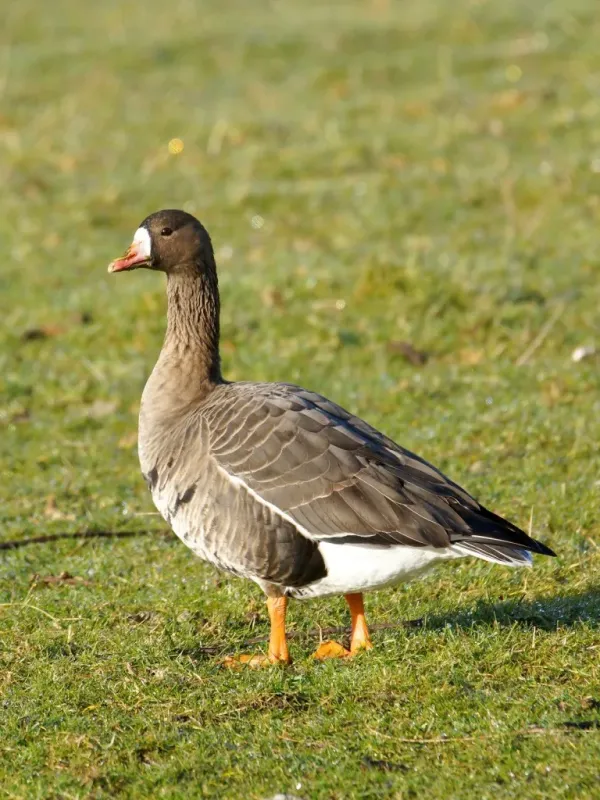
The Greater white-fronted goose (Anser albifrons) belongs to the Anseriformes order and Anatidae family. It is a migratory bird recognized by a distinctive white patch around its bill.
The adult plumage is characterized by a brownish base with bold black bars on the belly, which is a key identification feature for this species.
These geese are highly social and move in large flocks, which makes them significant consumers when they descend upon agricultural lands during migration.
They are well-adapted to long-distance flight and often select agricultural fields near wetlands as stopover points for feeding.
Their flight patterns and daily routines are highly consistent, allowing them to utilize the same fields repeatedly if left undisturbed.
What it damages
This species primarily damages winter grain crops, such as winter wheat and rye, as well as perennial grasses during their early growth stages.
The geese pull out young seedlings, causing severe crop thinning and preventing the plants from establishing a robust root system.
Heavy foraging by large flocks leads to significant defoliation, which can result in complete patch destruction within a matter of days.
Soil compaction caused by the weight of the birds, combined with the removal of vegetation, can degrade the soil surface quality.
The damage sustained during the winter and early spring periods is critical, as it directly impacts the plants' ability to yield during the harvest.
When it appears
The risk of damage is highest during the spring and autumn migration periods when the geese stop to rest and feed.
Autumn feeding usually coincides with the emergence of winter crops, making fresh shoots a primary target for the migrating birds.
Spring feeding occurs during the early regrowth of crops, providing essential nutrients for the geese before they head to their nesting grounds.
The duration of their stay is highly dependent on weather patterns, as sudden temperature drops may keep flocks in the same region for longer periods.
Morning and evening hours are the most intense periods of feeding activity, as the birds move from roosting sites to the fields.
Signs of infestation
The presence of these birds is indicated by distinct webbed footprints found across the soft soil surface of the field.
Accumulated goose droppings are a clear sign that a flock has been grazing on the specific area for an extended amount of time.
Foraged vegetation exhibits frayed and torn leaves, which is a typical sign of avian grazing rather than insect feeding.
Visible patches of bare soil within an otherwise lush crop indicate heavy foraging activity and the potential for severe yield loss.
Distinctive calling sounds of a flock are often the first sign that the geese have arrived at the site in the evening or early morning.
Control measures
Effective management requires a combination of scare tactics to discourage the geese from landing and staying on the crops.
Automated propane cannons are the standard solution for disrupting feeding behavior through periodic, loud noises.
- Installation of reflective tapes and streamers that flutter and create flashes of light in the wind.
- Deployment of predator decoys, such as owl or coyote models, which must be moved frequently to remain effective.
- Regular monitoring of the fields during migration to deploy scare tactics at the first sign of bird activity.
It is essential to vary the methods of deterrence, as the birds can quickly learn to ignore repeated, predictable scare stimuli.
Coordinating with neighboring farms to create non-crop "refuge areas" can help divert flocks away from valuable agricultural zones.
Taxonomy
- Latin name
- Anser albifrons
- Family
- Anatidae
- EPPO code
- ANSEAL
Discussion
No discussions yet — be the first.