
Asian long-horned beetle
Anoplophora nobilis
Description
How to identify
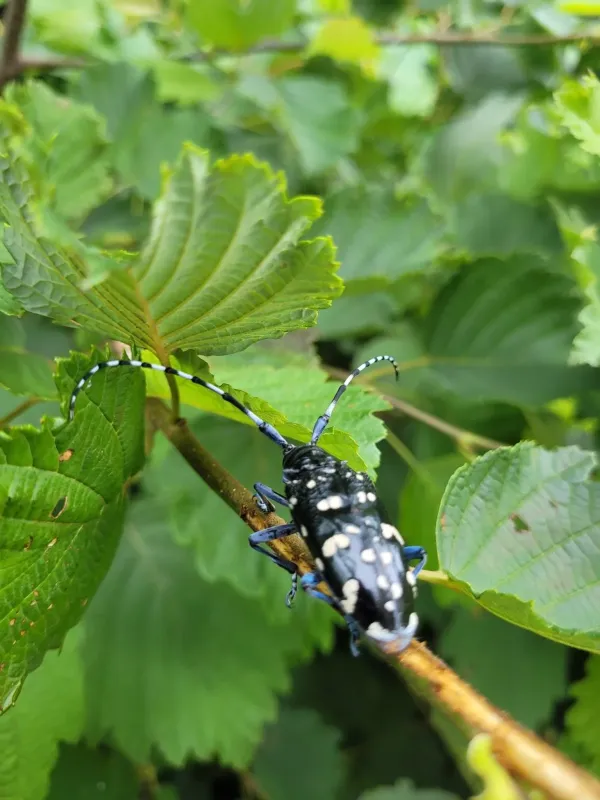
The Asian long-horned beetle is a large wood-boring insect belonging to the family Cerambycidae, order Coleoptera. Adult specimens feature a distinctive shiny black body with white markings on the elytra, resembling other species of the Anoplophora genus.
A primary characteristic of this pest is its extremely long antennae, which, especially in males, can significantly exceed the length of the body. The adult insect typically measures 25–35 mm in length and possesses a robust, elongated structure adapted for movement on tree bark.
The larvae are white or yellowish-white, legless, and possess a well-defined, sclerotized prothoracic plate. They can grow to significant sizes before pupation, boring deep and extensive galleries within the host wood.
Adult beetles have strong, chewing mouthparts used to pierce bark and wood. This biological trait is what makes them highly dangerous to a broad range of broad-leaved tree species.
This species is notoriously difficult to identify during early stages due to the cryptic nature of the adults, which are mostly nocturnal or crepuscular, making field monitoring challenging in various agricultural environments.
What it damages
The main hosts of this pest include various deciduous trees. Damaged crops and trees include maples, poplars, willows, horse chestnuts, elms, birches, apple trees, and other fruit-bearing varieties.
The primary damage is caused by the larvae, which, upon hatching, bore into the bark and eventually penetrate deep into the xylem. This activity disrupts the transport of water and nutrients within the plant tissues.
Prolonged larval activity within the trunk leads to weakened trees, branch dieback, and a significant loss of aesthetic and economic value. In severe cases, the infestation leads to the complete death of the tree.
Adult beetles feed on the bark of young twigs and leaves, causing additional stress to the plants, which is particularly destructive in nurseries and young orchards where trees are highly susceptible to physical damage.
The pest poses a severe threat to both forestry and horticulture, as it can easily spread through infested wood, wooden packaging materials, and traded nursery stock.
When it appears
The life cycle of the Asian long-horned beetle can last from one to two years depending on the local climate. Adults generally emerge in late spring or early summer.
The peak adult flight period occurs between June and August, during which mating takes place and females deposit eggs into individual niches carved into the tree bark.
Embryonic development lasts about two weeks, after which the larvae hatch. They begin active feeding just beneath the bark before moving deeper into the heartwood as they mature.
The larvae overwinter within the wood, surviving low temperatures in their protected galleries. With the arrival of spring warmth, they resume feeding and prepare a pupation chamber.
The pupal stage occurs inside the tree. Once metamorphosis is complete, the adult beetle chews a perfectly round exit hole through the bark and emerges to restart the reproductive cycle.
Signs of infestation
A key indicator of an infestation is the presence of perfectly round exit holes, approximately 10 mm in diameter, found on the trunks and major branches of host trees.
In areas where eggs have been laid, one can often observe small, funnel-shaped or pit-like scars on the bark surface created by the female before oviposition.
Accumulations of wood shavings and frass (a mix of excrement and sawdust) at the base of the tree or on branches are a strong indication that larvae are actively boring within the wood.
Premature yellowing or shedding of leaves, as well as the dieback of individual canopy branches, are frequent signs of a deep-seated larval infestation within the trunk.
Inspections often reveal vertical cracks in the bark or areas with sap weeping, which are typical defense reactions of the tree attempting to cope with damage to its vascular system.
Control measures
The primary control measure is strict quarantine regulation designed to prevent the movement of infested nursery stock and wood products from regions where the pest is established.
Ongoing monitoring of plantations, utilizing visual tree inspections and pheromone traps, is essential for the early detection and localization of potential outbreaks.
If an infestation is detected, infested trees must be immediately felled and destroyed via burning or deep burial, as chemical insecticides are largely ineffective against larvae hidden inside the wood.
Preventative strategies include maintaining tree health, removing weakened or diseased specimens, and adhering to high-standard agricultural practices in gardens and urban parks.
Some regions are researching biological control methods, such as attracting natural predators or using entomopathogenic fungi, but phytosanitary measures remain the first line of defense.
Taxonomy
- Latin name
- Anoplophora nobilis
- Order
- Coleoptera (beetles)
- Family
- Cerambycidae
- EPPO code
- ANOLNO
Discussion
No discussions yet — be the first.