
Anoplophora horsfieldii
Anoplophora horsfieldii
Description
How to identify
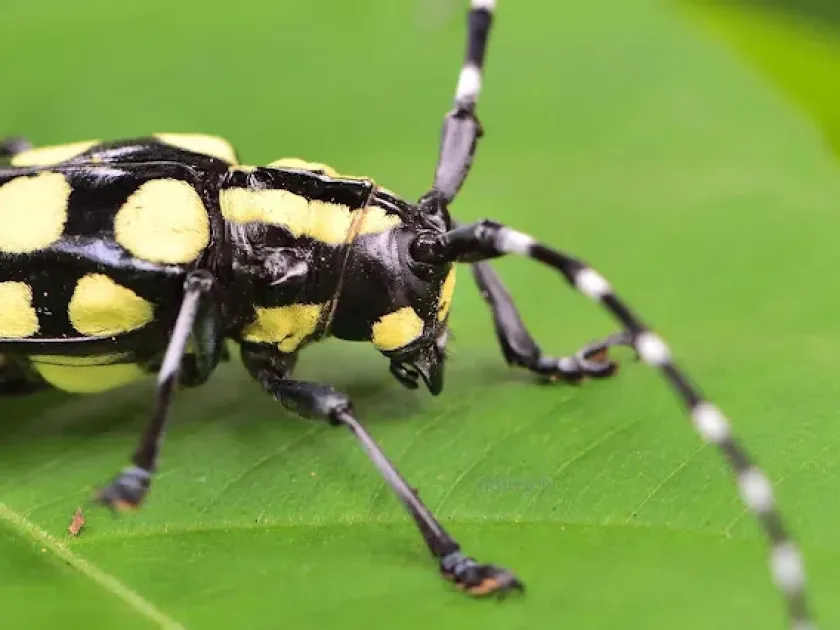
Anoplophora horsfieldii is a member of the Cerambycidae family, commonly known as longhorn beetles. These insects are distinguished by their striking black body with white or pale-yellow markings on the elytra and exceptionally long antennae that often exceed the length of their body.
The larvae are cylindrical, legless, and white to yellowish, with a robust head and strong mandibles designed for boring through hard plant tissues. Adults are relatively large, often ranging between 30 and 40 millimeters, making them highly visible during the flight season.
What it damages
This beetle primarily attacks deciduous trees, with a strong preference for species within the Rosaceae and Salicaceae families. Common hosts include apple, pear, and plum trees, as well as various ornamental species such as willow and poplar, which are frequently targeted in urban landscapes.
The damage is caused primarily by the larvae, which tunnel deep into the woody parts of the tree. These galleries disrupt the flow of water and nutrients, which eventually leads to the dieback of branches and can compromise the entire structural integrity of the host tree.
When it appears
The life cycle of Anoplophora horsfieldii typically spans one to two years, depending on regional temperature and host availability. Adult beetles emerge during the warmer months, usually peaking from June through August, which coincides with their mating and egg-laying period.
Females create small notches in the tree bark using their mandibles to deposit their eggs. Once the eggs hatch, the larvae bore into the sapwood and heartwood, remaining protected inside the tree for the majority of their developmental stages until they reach the pupal stage.
Signs of infestation
Visible signs of an infestation include small, circular exit holes on the trunk or branches created by emerging adults. Often, piles of frass, which looks like coarse sawdust, can be found accumulating near the base of the tree or within the crevices of the bark.
Infected trees often display thinning canopies, premature yellowing of leaves, and the progressive death of individual branches. Over time, the structural weakening of the wood can lead to wind-breakage, potentially causing the entire tree to collapse under mechanical stress.
Control measures
Controlling Anoplophora horsfieldii is challenging due to the larvae residing deep within the wood, making chemical treatments less effective once the tree is heavily infested. Therefore, integrated pest management focuses heavily on monitoring and phytosanitary practices.
- Regular field inspections to identify early stages of colonization.
- Removal and destruction of infested branches or entire trees by burning.
- Application of systemic insecticides during the emergence period to reduce the adult population.
- Use of pheromone traps for monitoring and early detection of the beetles.
Taxonomy
- Latin name
- Anoplophora horsfieldii
- Order
- Coleoptera (beetles)
- Family
- Cerambycidae
- EPPO code
- ANOLHO
Discussion
No discussions yet — be the first.