
Six-spotted longhorn beetle
Anoplodera sexguttata
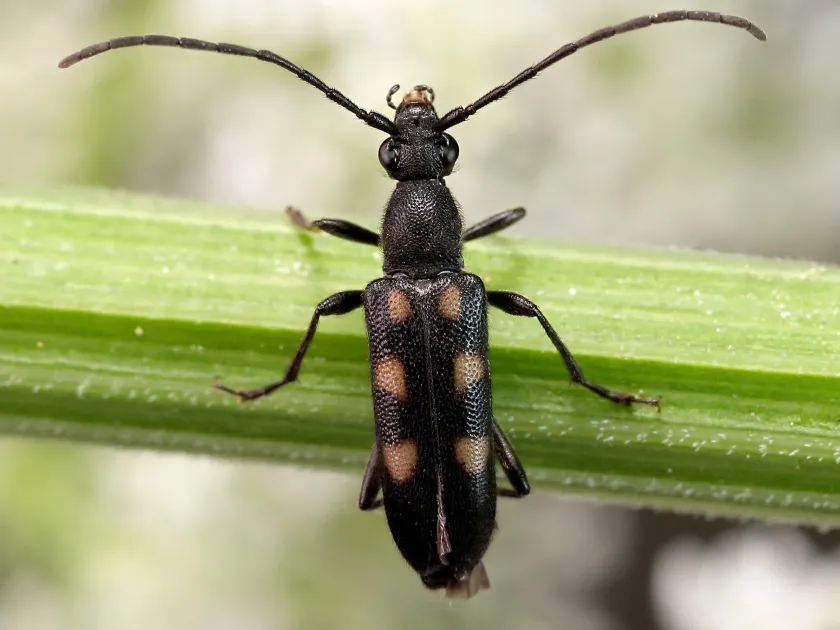
Description
How to identify
The Six-spotted longhorn beetle (Anoplodera sexguttata) is a small beetle belonging to the family Cerambycidae, often encountered in temperate forests.
The adult beetle typically reaches a body length between 7 and 12 mm, with an elongated, slender shape that tapers toward the posterior end.
The coloration of the elytra is dark brown or black, adorned with characteristic yellow or cream-colored spots, usually arranged in three distinct pairs.
The head and pronotum feature dense, fine punctuation, giving the insect a matte appearance rather than a shiny finish.
Larvae are typical wood-boring grubs with a pale, whitish body and a well-developed, chitinized head capsule capable of chewing through tough fibers.
What it damages
This species is considered a secondary pest, primarily targeting weakened, dying, or recently felled broadleaf trees, including oak, beech, and hornbeam.
Larvae feed within the woody tissues of the host, creating tunnels that degrade the internal structure of branches and trunks over time.
While healthy trees are rarely the target, the beetle significantly accelerates the decay of trees already stressed by drought, disease, or mechanical injury.
Tunneling activity creates entry points for various pathogenic fungi, which can ultimately lead to the total collapse of the infested woody tissues.
In forest management, its impact is usually limited to accelerating the breakdown of fallen timber, though it can become problematic in stockpiled logs.
When it appears
The flight period of adult beetles occurs from May to July, coinciding with warm weather conditions favorable for their mating and dispersal.
The development cycle from egg to adulthood usually spans two years, with the larval stage spending the majority of this time inside the wood.
Winter is passed in the larval stage deep within the wood, which provides insulation against freezing temperatures during the dormant season.
Pupation takes place in the spring within specialized chambers excavated by the larvae near the surface of the bark.
Adults are frequently observed feeding on the pollen and nectar of umbelliferous plants near their host trees during the active spring and summer months.
Signs of infestation
The presence of this beetle is indicated by small, circular exit holes on the bark where the adults have successfully emerged.
Fine wood dust or frass found at the base of the tree or within bark fissures is a classic sign of internal larval feeding activity.
Visual symptoms on the canopy, such as yellowing leaves, dieback of individual branches, or premature defoliation, suggest significant vascular disruption.
Loosening or peeling bark on parts of the trunk is a strong indicator that the wood has been compromised by the galleries of the larvae.
Direct observation of adult beetles on the bark or nearby flowers during the spring months confirms the population's presence in the area.
Control measures
The primary control method involves good forest hygiene, specifically the prompt removal and disposal of dead, dying, or infested tree materials.
Log storage should be managed to ensure that wood is removed from the site before the adult flight period begins in the spring.
Pheromone-baited traps can be deployed in high-value areas to monitor beetle populations and reduce the density of adults during the peak flight season.
Maintaining high tree vitality through appropriate silvicultural practices, such as thinning and adequate irrigation, helps prevent secondary attacks.
Encouraging natural predators, such as woodpeckers and various parasitoid wasps, can help keep the population levels in balance within natural ecosystems.
Taxonomy
- Latin name
- Anoplodera sexguttata
- Order
- Coleoptera (beetles)
- Family
- Cerambycidae
- EPPO code
- LPTUSE
Discussion
No discussions yet — be the first.