
Anoplistes halodendri
Anoplistes halodendri
Description
How to identify
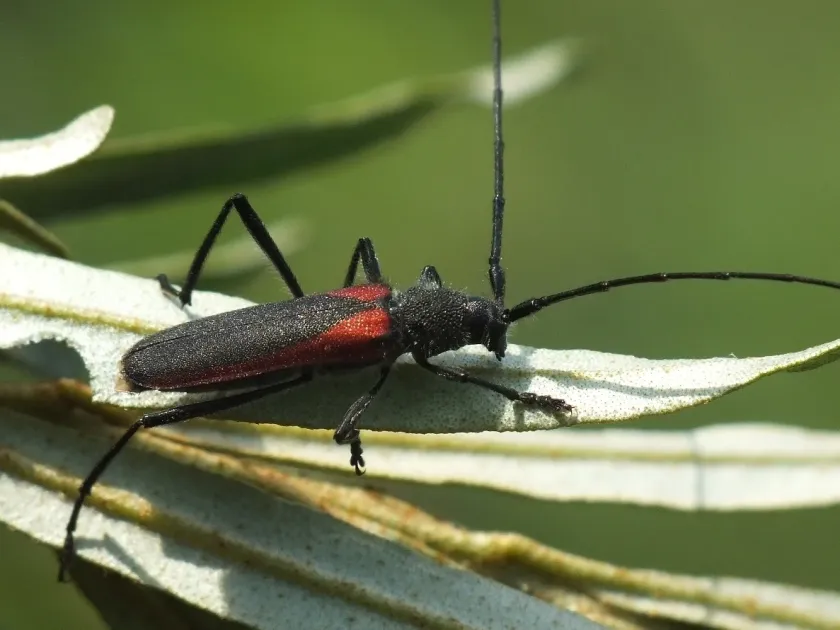
Anoplistes halodendri is a species of longhorn beetle belonging to the family Cerambycidae, order Coleoptera. Adult beetles measure 12–25 mm in length and are distinguished by their black bodies adorned with bright yellow or orange markings on the elytra.
The larvae are typically legless, white, and equipped with strong mandibles designed for boring deep galleries into woody plant tissues. This subterranean existence makes them particularly difficult to detect in the early stages of infestation.
The biological cycle of this beetle usually spans two years, influenced significantly by local climate conditions and the physiological state of the host plant. Adults are primarily active during the summer, when they engage in mating and oviposition.
This species is a typical xylophage, showing a preference for weakened or diseased specimens; however, it can also infest healthy trees when population densities reach critical levels.
Successful identification involves observing the characteristic exit holes on the bark, which appear as small, circular, or oval openings where the emerging adult beetles have exited.
What it damages
The primary hosts for Anoplistes halodendri include plants in the Fabaceae family, particularly Caragana (Siberian peashrub), as well as willow, poplar, elm, and various fruit-bearing trees.
Larval feeding activity occurs within the inner bark and sapwood, where they carve extensive galleries that disrupt the vascular system of the tree, impeding water and nutrient transport.
Young plantations are at high risk, as larval feeding can lead to girdling, which often results in the rapid death of the entire tree within a single season.
In addition to direct mechanical damage, these galleries serve as entry points for secondary pathogens, including wood-decay fungi and opportunistic bacteria, which further degrade the tree's structure.
Economic damage is notable in forestry and urban landscaping, where the loss of trees leads to reduced aesthetic appeal and significant maintenance costs for removal and replacement.
When it appears
The emergence of adult beetles typically occurs from late spring through the summer months, with peaks observed in June and July as they seek mating partners and suitable host trees.
Larval activity continues throughout the entire growing season, as they are protected inside the wood, where ambient temperature fluctuations are minimized.
Overwintering occurs as larvae within specially constructed chambers deep inside the wood, where they remain in a state of diapause until the return of warmer weather in spring.
In warmer southern regions, development can be accelerated, potentially leading to more frequent or overlapping generations, which increases the pressure on local tree populations.
The transition from larvae to pupae and finally to adults follows a strict seasonal pattern, making the spring and early summer the most critical time for monitoring.
Signs of infestation
A primary indicator of infestation is the presence of fine sawdust (frass) emerging from small cracks or entry holes in the bark, indicating active feeding by larvae within.
Visible symptoms on the host plant include early leaf yellowing, wilting, and premature leaf drop, which often signal that the tree's vascular system is under stress.
Upon closer inspection of the bark, one may find irregular, winding galleries packed with wood shavings, which confirm the presence of wood-boring larvae.
The appearance of clean-cut, oval exit holes on the trunk or large branches is a definitive sign that the beetle population has successfully completed its development.
Increased woodpecker activity on a specific tree is a strong indicator of larvae presence, as birds often hunt the beetles burrowing beneath the bark.
Control measures
The most effective management strategy is the prompt removal and destruction of heavily infested trees before adult beetles emerge in the spring.
Maintaining high tree vigor through proper irrigation, fertilization, and general agronomic care helps trees build natural defenses against wood-boring pests.
For high-value ornamental trees, systemic insecticides applied during the peak emergence period of adults can prevent new infestations by deterring oviposition.
Monitoring using pheromone traps is an essential component of integrated pest management, allowing for precise timing of chemical or physical interventions.
- Sanitation pruning to remove dead or dying branches.
- Mechanical bark cleaning to remove oviposition sites.
- Encouraging natural bird populations as biological control agents.
- Regular field scouting during the spring and summer.
Taxonomy
- Latin name
- Anoplistes halodendri
- Order
- Coleoptera (beetles)
- Family
- Cerambycidae
- EPPO code
- PURPPI
Discussion
No discussions yet — be the first.