
Common Teal
Anas crecca
Description
How to identify
The Common Teal (Anas crecca) is the smallest dabbling duck within the Anatidae family, known for its high agility and rapid, explosive take-off from water surfaces.
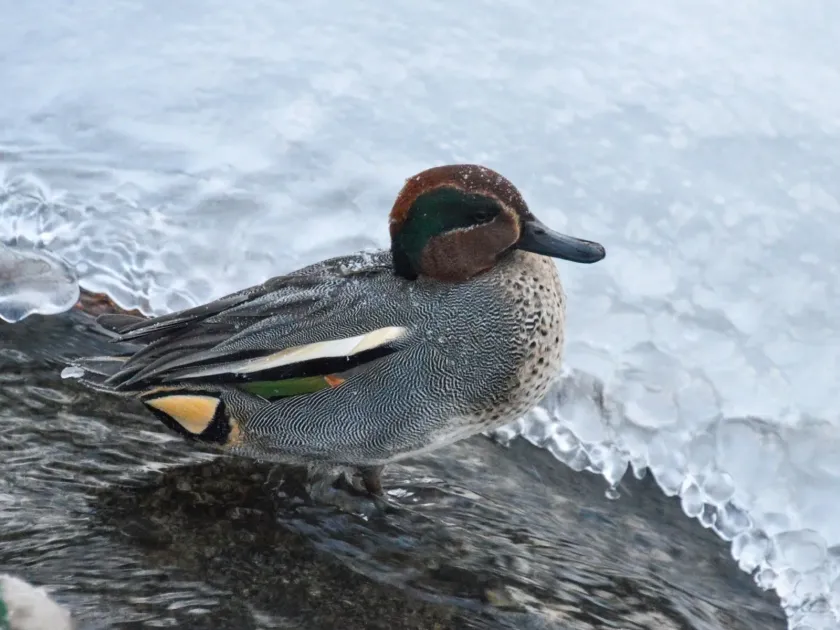
During the breeding season, males display distinctive green patches behind their eyes, while females possess mottled brown plumage, which provides excellent camouflage in dense wetland vegetation.
In agricultural settings, these birds are considered opportunistic feeders that frequently exploit flooded fields, especially rice paddies, as staging areas during their migration cycles.
Their biological behavior involves congregating in large groups, which significantly increases the risk of concentrated damage to agricultural crops located near their stopover sites.
Highly adaptive to various aquatic environments, the Common Teal quickly integrates flooded man-made fields into their daily foraging routes if natural wetlands are scarce.
What it damages
The primary agricultural damage caused by the Common Teal occurs in rice paddies during the initial phases of germination and the establishment of seedlings.
By consuming sprouted seeds directly from the soil, the ducks create significant thinning in the crops, often forcing farmers to undertake costly re-seeding operations.
Cereal crops near wetlands are also at risk, as the birds forage by trampling young plants, which negatively impacts the crop density and overall uniformity of the field.
Excessive trampling leads to soil compaction, reducing root aeration and nutrient uptake efficiency for the growing cereal plants, thereby affecting overall growth.
While individual birds consume small amounts, the cumulative impact of large migrating flocks can lead to substantial economic loss over a short period of time.
When it appears
The peak risk to agricultural fields coincides with the spring migration period when large flocks arrive to rest and feed after long-distance flights.
During the summer months, while the birds are less concentrated, rice fields remain vulnerable due to the constant water levels that mimic their natural habitats.
Autumn migrations present a secondary risk, particularly if harvesting is delayed or if the birds find freshly sown winter cereal fields along their flight paths.
Local weather patterns, such as sudden cold snaps or heavy rains, often influence how long these flocks linger in a specific agricultural region.
Farmers should be especially vigilant from March through May, as this is the most critical window for crop establishment and potential avian impact.
Signs of infestation
One of the most noticeable signs of Common Teal activity is the appearance of bare patches in a field where germinating seeds have been completely removed.
The presence of webbed foot tracks in the soft, wet soil of the rice paddies clearly indicates the birds have been moving through the crop.
Accumulations of avian excrement along the field boundaries or on the edges of irrigation ditches suggest frequent and prolonged foraging by the flock.
Mechanical breakage of the young stems and leaves is a frequent indicator of the ducks' presence as they walk and feed through the dense plant canopy.
- Bare spots in seeded fields.
- Webbed footprints in the mud.
- Significant amounts of bird droppings.
- Broken or crushed young cereal stems.
Control measures
Effective management includes the deployment of acoustic deterrents, such as gas cannons or ultrasonic devices, to disrupt the birds' sense of security in the fields.
Visual aids like reflective tape, silhouette decoys of predators, or kite-based scarers help to prevent the ducks from settling in high-value crop areas.
Modifying water levels in paddies at critical times can render the foraging conditions less suitable, encouraging the flocks to move to alternative wetlands.
Regular monitoring and patrolling of fields act as a continuous disturbance, which prevents the birds from becoming comfortable in the agricultural area.
Establishing buffer zones with natural vegetation away from productive fields can help manage bird populations by offering them non-destructive foraging options.
Taxonomy
- Latin name
- Anas crecca
- Family
- Anatidae
- EPPO code
- ANAXCR
Discussion
No discussions yet — be the first.