
Green-winged teal
Anas carolinensis
Description
How to identify
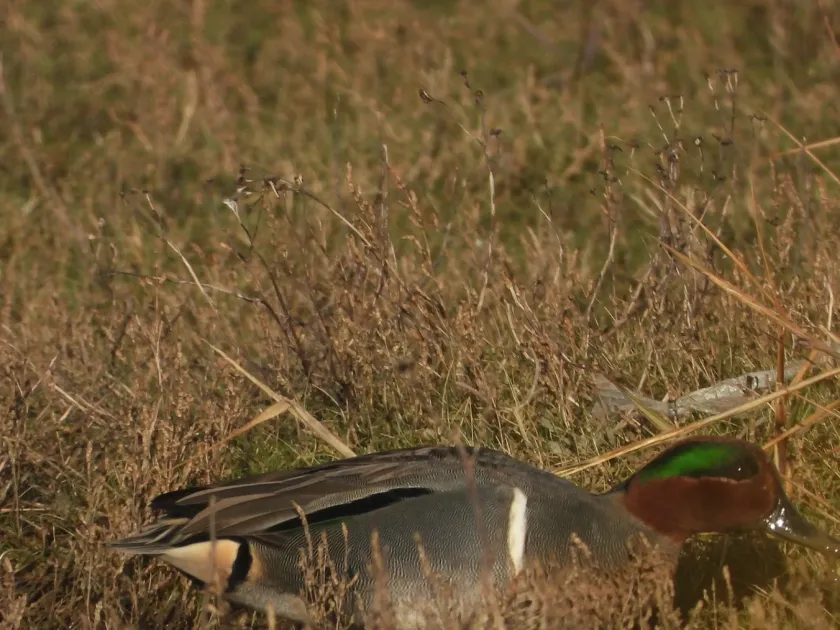
The Green-winged teal (Anas carolinensis) is a small dabbling duck belonging to the family Anatidae and the order Anseriformes. The male, in its breeding plumage, is easily identified by its chestnut-colored head featuring a wide, iridescent green stripe extending from the eye to the nape.
Females and immature birds possess a mottled, brownish-gray plumage that provides excellent camouflage in reeds and tall grasses. In flight, the most recognizable feature is the bright green speculum on the wings, which serves as a diagnostic mark for the species.
These ducks are highly agile, capable of springing directly from the water or land into flight, which makes them swift to evade potential threats. They often gather in flocks, occupying flooded agricultural lands, wetlands, and irrigation ditches.
The biological cycle of the species is linked to migratory patterns. During migration, these ducks utilize agricultural fields as temporary stopovers to feed, particularly after harvest or during the early stages of crop development.
Their adaptive behavior allows them to exploit a variety of environments. When natural food sources are scarce, they readily shift their attention to cereal crops and newly sown fields, causing significant agricultural disturbances.
What it damages
The Green-winged teal can be a destructive pest in rice paddies and wetlands, especially during the seeding stage. They are known to graze on emerging shoots and dig for seeds submerged in the shallow water of flooded fields.
Beyond crop consumption, they cause mechanical damage by trampling seedlings and compacting the soil. This disruption can lead to uneven crop growth and may necessitate costly replanting efforts in severely affected areas.
The damage is most pronounced during spring and autumn migrations when large numbers of ducks congregate. A single flock can cause localized but severe losses if not actively managed by farm operators.
Waterfowl contamination of irrigation water is another concern. Their feces introduce waste into the water supply, which can potentially lead to the degradation of water quality and the spread of plant pathogens within the agricultural system.
In highly intensive farming areas, the cumulative impact of these birds can significantly lower yields. Their habit of feeding in groups exacerbates the speed at which a field can be cleared of its newly sown seeds.
Signs of infestation
The primary indicators of bird activity are webbed footprints found in mud or shallow water. These tracks are distinct and indicate the presence of significant waterfowl populations in the vicinity of the fields.
Evidence of feeding includes uprooted seedlings and small holes in the soil where the ducks have been foraging for seeds. Large quantities of feathers and avian feces near the edges of fields also confirm their activity.
Visual observations often reveal patches of damaged or missing crops, often referred to as "bare spots." These spots usually correlate with areas where the ducks have been resting or congregating for feeding sessions.
Auditory signs, such as the distinctive whistling or "krik-krik" calls of the males, often precede visual sightings. These noises are particularly audible during dawn and dusk when the ducks are most active.
The presence of disturbed water surfaces and muddying of the irrigation channels serves as an indirect sign that a flock has been active in the area throughout the day or night.
Control measures
Acoustic deterrents, such as programmable gas cannons or digital sound systems that play distress calls and predator sounds, are effective tools for scaring away flocks from vulnerable fields.
Visual deterrents, including hawk kites or predatory bird models, can be used. It is essential to move these devices periodically, as birds can learn to recognize the decoys as non-threatening if they remain stationary for too long.
Agrotechnical strategies, such as flooding fields to a depth that makes it difficult for ducks to reach seeds, or conversely, maintaining dry conditions where possible, can help manage the impact of the pests.
Active patrol during peak migration periods is a labor-intensive but effective method to push the flocks off the land. Integrating these methods with modern monitoring technology ensures the best protection for the harvest.
- Utilizing automated propane cannons.
- Deploying reflective bird tape or scarecrows.
- Monitoring fields during critical growth stages.
Taxonomy
- Latin name
- Anas carolinensis
- Family
- Anatidae
- EPPO code
- ANAXCA
Discussion
No discussions yet — be the first.