
Anaglyptus simplicornis
Anaglyptus simplicornis
Description
How to identify
Anaglyptus simplicornis belongs to the family Cerambycidae, commonly known as longhorn beetles. As a member of the tribe Clytini, this species is specialized in developing within the wood of various deciduous trees.
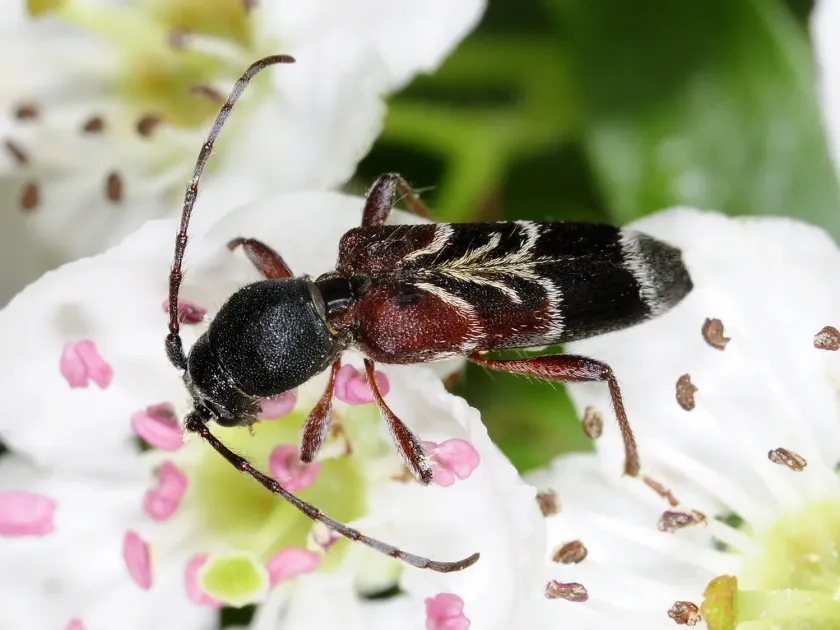
Adult beetles are relatively small, characterized by an elongated body shape and distinct coloration, which usually consists of light markings against a darker background on the elytra. Their antennae are of moderate length compared to other cerambycids.
These beetles exhibit cryptic behavior, often found in forests, orchards, or parklands. They are proficient fliers, allowing them to locate suitable hosts across significant distances during their active season.
The larvae are typical wood-borers: white, soft, cylindrical in appearance, with a robust head and strong mandibles designed for excavating wood tunnels. This larval stage is the primary cause of damage to host plants.
The biological cycle typically ranges from one to two years, significantly influenced by local climate and the nutritional quality of the wood. Stable environmental conditions often lead to persistent local populations.
What it damages
The beetle primarily attacks a variety of deciduous trees, including fruit species such as apples, pears, as well as forest trees. Weakened, stressed, or aging trees are significantly more susceptible to infestation.
Larvae feed beneath the bark and deep into the sapwood, creating complex networks of galleries. These tunnels disrupt the tree's vascular system, hindering the transport of water and essential nutrients from the roots to the crown.
Severe infestations reduce the structural integrity of the tree, making it prone to breakage during high winds. Over time, the damage can lead to the wilting and eventual death of individual branches or the entire tree.
The galleries carved by the larvae serve as entry points for secondary pathogens, such as fungi and bacteria, which can accelerate wood rot and further deteriorate the tree's health.
In ornamental and orchard settings, this pest is particularly problematic as it damages the aesthetic value and fruit-bearing potential of the vegetation, requiring diligent monitoring.
When it appears
Adult emergence typically occurs during the warmer months, generally from late spring to mid-summer. During this phase, they are active, mating and searching for suitable sites to deposit their eggs on the bark.
The larval stage remains active throughout most of the growing season. Because they reside within the wood, they are protected from most environmental threats and typical garden predators.
Overwintering occurs while the insect is in the larval stage, deep inside the trunk or branches. This allows the pest to survive freezing temperatures, protected by the insulation provided by the host wood.
Pupation generally takes place in the spring. After a period of development, the new generation of adults bores its way out, leaving characteristic exit holes on the tree's surface.
Because generation cycles may overlap, one might observe multiple stages of development within a single season, leading to continuous pressure if not managed properly.
Signs of infestation
The most prominent indicator of an infestation is the presence of small, oval-shaped exit holes on the bark, indicating that adult beetles have recently emerged from the wood.
Frass, which resembles fine sawdust, often accumulates at the base of the trunk, in bark crevices, or within branch junctions, signifying active larval feeding deep inside the wood.
Visual decline in the tree crown, such as premature yellowing of leaves or the sudden wilting of specific branches, is a clear warning sign of underlying vascular damage caused by boring.
Bark may appear depressed or loose in localized areas where larvae have been feeding, often accompanied by discoloration or subtle cracking of the surface.
- Oval-shaped exit holes (2-4 mm) on bark
- Accumulation of fine sawdust (frass) near the trunk
- Premature leaf yellowing or branch wilting
- Brittle branches prone to breakage
- Overall loss of tree vigor and sap flow
Control measures
Sanitation is the most effective control method: prune and dispose of infested wood promptly by burning. This prevents the emergence of new adult beetles and reduces the local population density.
Maintaining tree health through proper fertilization, adequate watering, and sound horticultural practices strengthens the plant's natural resistance, making it less attractive to the pest.
If caught early, localized control can be achieved by injecting systemic insecticides directly into the larval galleries, which can effectively target the hidden larvae.
The use of pheromone traps during the adult flight period is a reliable way to monitor populations and prevent mass egg-laying on healthy plants.
When necessary, contact insecticides can be applied as a preventive bark spray during the flight season to deter females from laying eggs on the bark surface.
Taxonomy
- Latin name
- Anaglyptus simplicornis
- Order
- Coleoptera (beetles)
- Family
- Cerambycidae
- EPPO code
- ANALSI
Discussion
No discussions yet — be the first.