
Anaglyptus mysticoides longhorn beetle
Anaglyptus mysticoides
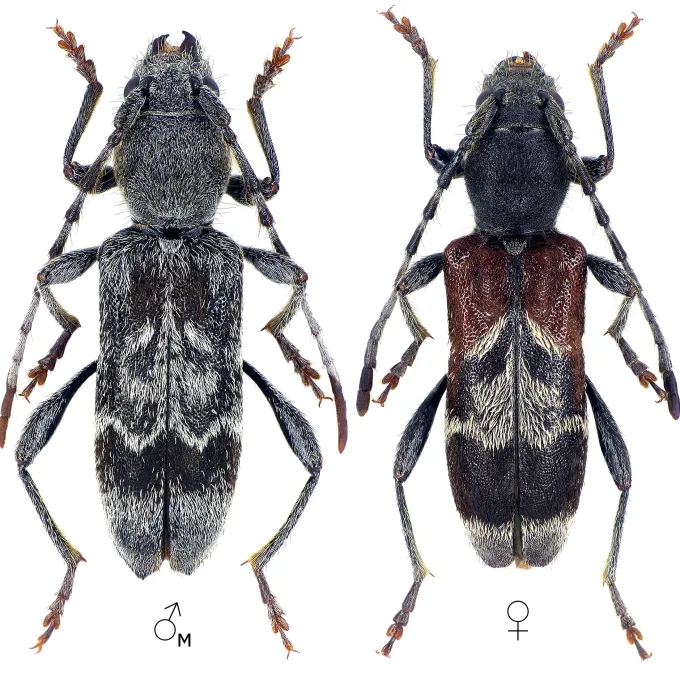
Description
How to identify
Anaglyptus mysticoides belongs to the order Coleoptera and the family Cerambycidae, commonly known as longhorn beetles. These insects are well-adapted to boring into woody tissues during their larval stage.
The adult beetle possesses a distinctive pattern on its elytra, which serves as a key feature for taxonomic identification among the subfamily Cerambycinae.
Larvae are typically white, fleshy, and legless, equipped with strong mandibles that allow them to tunnel through tough wood, causing internal structural damage.
The life cycle is intimately linked to the health of the host tree, as these beetles predominantly target weakened or decaying specimens in temperate forests and orchards.
Detailed entomological studies highlight their role in forest dynamics, where they act as secondary pests that accelerate the decomposition of stressed woody plants.
What it damages
This beetle primarily affects various deciduous trees, including fruit-bearing species like apples and pears, as well as several wild woody plants.
Larval activity involves tunneling beneath the bark and into the sapwood, which disrupts the transport of water and nutrients, causing localized dieback.
Trees stressed by drought, poor soil conditions, or other diseases are the most vulnerable to infestation and eventual decline.
Persistent infestations lead to a gradual loss of tree vigor, resulting in reduced fruit yield and long-term damage to the tree architecture.
In severe cases, the cumulative damage from larval tunnels makes the tree susceptible to windbreak and other secondary pathogens.
When it appears
Adult emergence typically occurs during the spring and summer months when warm temperatures trigger reproductive activities.
Females deposit eggs in the bark crevices of host trees, particularly in areas where the bark is already cracked or damaged.
The larval stage is the most destructive period, with larvae feeding continuously inside the wood throughout the growing season.
Overwintering occurs in the larval stage deep within the woody tissue, providing protection against extreme cold and environmental fluctuations.
Pupation takes place inside the wood, followed by the adult beetle chewing its way out to complete the life cycle in the following year.
Signs of infestation
The most reliable sign of an active infestation is the presence of small, characteristic exit holes on the surface of the tree bark.
Fine wood dust or frass, produced by the larvae during their boring activity, may be found accumulating in crevices or at the base of the trunk.
Visual symptoms include yellowing leaves and wilting branches, which indicate that the internal vascular tissues have been severely compromised.
Bark splitting or peeling on the main trunk often reveals the underlying galleries created by the larvae as they feed on the wood.
A overall decline in tree health, including stunted growth and poor foliage density, is a classic indicator of a long-standing wood-boring pest problem.
Control measures
Effective management begins with maintaining high cultural standards, which include regular pruning to remove dead or dying branches that attract beetles.
Keeping the trees healthy through proper irrigation and fertilization is the best defense against wood-boring pests, as vigorous trees are more resistant.
Mechanical control measures, such as scraping loose bark and applying whitewash to trunks, can deter females from laying eggs.
Targeted chemical applications during the peak flight period can significantly reduce adult populations and subsequent larval infestations.
- Regular site monitoring for exit holes.
- Prompt disposal of infested wood by burning.
- Application of insecticide during flight.
- Maintaining tree vigor through consistent care.
Taxonomy
- Latin name
- Anaglyptus mysticoides
- Order
- Coleoptera (beetles)
- Family
- Cerambycidae
- EPPO code
- ANALMY
Discussion
No discussions yet — be the first.