
March moth
Alsophila aescularia
Description
How to identify
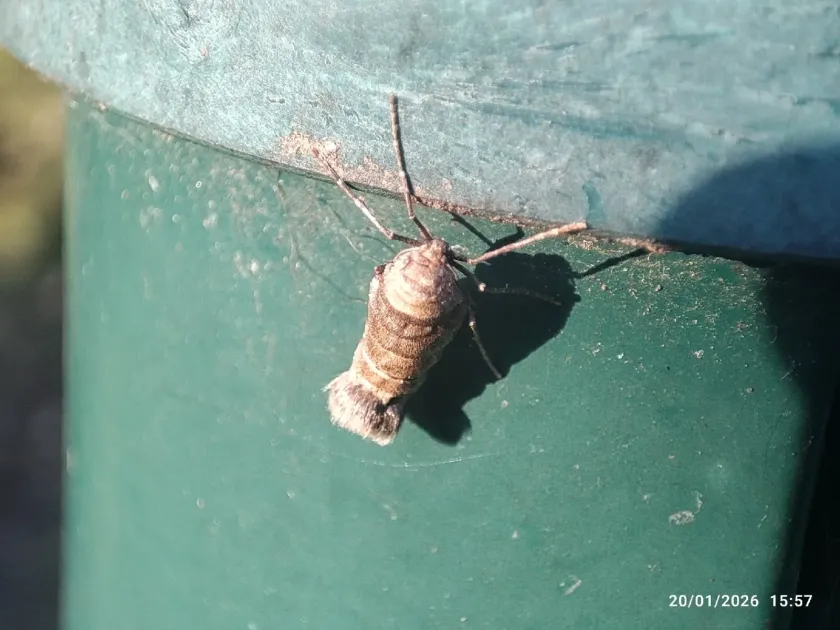
The March moth (Alsophila aescularia) is a species of moth belonging to the family Geometridae. The species exhibits extreme sexual dimorphism, where the males are winged, while the females are flightless and possess a stout, hairy body, making them entirely dependent on crawling.
Adult males have a wingspan of approximately 30–35 mm with brownish-grey coloration. The flightless females, which emerge in early spring, must climb host trees to lay their eggs, making them particularly vulnerable to sticky barrier traps.
The larvae are typical inchworms, moving in a looping motion by drawing their hind legs toward their thoracic legs. When fully grown, the larvae measure up to 30 mm and are predominantly light green with longitudinal pale stripes.
The life cycle involves pupation within a tough, silk-lined cocoon buried in the soil under the host tree. They overwinter as pupae, emerging as adults usually between February and April, depending on local temperatures.
Eggs are laid in clusters, often hidden in the forks of young twigs or near buds. These clusters are usually covered with protective hairs from the female's abdomen to shield them from environmental factors and predators.
What it damages
The March moth is a polyphagous pest, meaning it feeds on a variety of broad-leaved trees and shrubs. It is primarily recognized as a pest in orchards, specifically targeting apples, pears, plums, and cherries.
Beyond cultivated fruit trees, the species often thrives on deciduous forest trees such as oak, elm, lime, and maple. The larvae begin feeding immediately upon hatching, targeting developing buds and tender young leaves.
Heavy infestations can lead to significant defoliation, which hampers the tree's ability to photosynthesize effectively during the critical spring growth phase. This stress directly correlates to reduced fruit yield and poorer quality of the harvest.
Feeding larvae also frequently consume floral buds and young fruitlets, causing premature fruit drop. This loss of reproductive tissue is a major concern for commercial fruit growers and home gardeners alike.
In addition to direct consumption, the feeding sites create entry points for secondary pathogens and attract other opportunistic pests, potentially worsening the overall health of the tree.
Signs of infestation
One of the earliest signs of activity is the presence of webbed or curled leaves in early spring. The larvae use silk to bind leaf edges together, creating a safe environment while they consume the leaf tissue.
The presence of flightless females crawling up trunks in early spring is a clear indicator of a potential infestation. Gardeners often monitor this by checking for females caught in grease bands or sticky traps.
The foliage often shows irregular holes or complete skeletonization, leaving only the midribs and main veins of the leaves intact. A visual inspection of the canopy can easily reveal these damaged leaves.
When disturbed, the larvae often drop from the branches on fine silk threads. This behavior allows for a simple "shake test" to determine if the population density requires further management actions.
In cases of high population pressure, the presence of frass (caterpillar droppings) on the leaves or the ground beneath the canopy indicates that active feeding is taking place throughout the tree structure.
Control measures
Grease banding or the application of sticky barriers to the tree trunk is the most effective preventative measure. This mechanical barrier prevents the flightless females from reaching the canopy to lay their eggs.
Cultivating the soil beneath the trees in late autumn or early winter helps destroy the pupae overwintering in the ground. This physical disturbance significantly reduces the population that will emerge the following spring.
Chemical intervention should be reserved for periods of high infestation where natural control methods are insufficient. Insecticides should be applied during the larval stage, ideally targeting young caterpillars before they cause extensive damage.
Biological control using Bacillus thuringiensis sprays is a highly effective and eco-friendly method. These sprays target the larvae specifically and have minimal impact on beneficial predatory insects or pollinators.
- Monitor the trees using pheromone traps (for males) or sticky bands (for females).
- Encourage insectivorous birds in the orchard to predate on the larvae.
- Prune trees regularly to ensure good visibility for inspections and proper air circulation.
Taxonomy
- Latin name
- Alsophila aescularia
- Order
- Lepidoptera (butterflies)
- Family
- Geometridae
- EPPO code
- ALSOAE
Discussion
No discussions yet — be the first.