

Pest · Coleoptera (beetles) · affects Cereals, Winter wheat, Theaceae
Sawtoothed grain beetle
Ahasverus
Description
How to identify
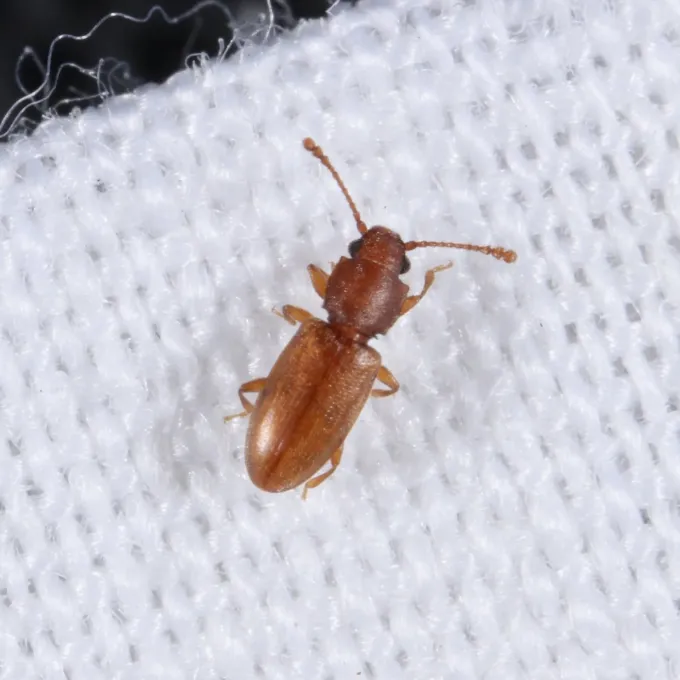
The sawtoothed grain beetle (Ahasverus advena) is a small insect measuring between 2.5 and 3.5 mm in length. Its body is flattened, allowing it to crawl into tight crevices in packaging and storage facilities.
The insect is easily identified by the distinct, tooth-like projections on the sides of its thorax. This feature, combined with its brown, elongated appearance, makes it distinct from other common storage beetles.
The larvae are small, pale, and have a segmented appearance. They possess strong mandibles and legs, enabling them to move through bulk grains and food products to reach nutritional sources.
Adult beetles are capable of flight, which facilitates their rapid spread across warehouses. They are highly adaptive to varying environmental conditions, though they favor high humidity levels.
Their ability to survive in small amounts of leftover dust or residue makes them extremely difficult to eradicate from commercial storage settings without thorough sanitation.
What it damages
This beetle is a serious pest of a wide array of food products. It commonly infests flour, cereals, wheat, oats, corn, and processed grains. It is also frequently found in dried fruits, nuts, and spices.
Both adults and larvae feed by consuming the product. They chew into whole grains or break down flour particles, significantly reducing both the volume and the quality of the stored goods.
Damage caused by this beetle often leads to secondary issues. By creating heat and moisture pockets, they promote the growth of mold and yeast, which can spoil an entire storage batch.
Once products are infested, they become unsellable due to contamination by beetle fragments, larvae, and excrement. The resulting musty odor is often impossible to remove through standard cleaning methods.
For agribusiness, the economic impact is significant, as it leads to product rejection, increased costs for fumigation, and potential damage to the company's reputation.
When it appears
The lifecycle of the beetle is highly temperature-dependent. At optimal conditions of 25°C to 30°C and 60% relative humidity, a full generation can develop in less than a month.
While their activity slows down in cooler environments, they do not necessarily die. They can remain dormant or continue to develop very slowly, ensuring that a colony persists across seasons.
Females lay eggs in batches within the substrate. Given the short development time, a single infestation can explode into a massive population if conditions remain stable for a few weeks.
Warehouses that are kept warm, especially during winter months, are at the highest risk for persistent year-round infestations, requiring constant vigilance and monitoring.
Seasonal spikes in activity usually coincide with warmer months or the arrival of new grain harvests, which may already be contaminated during transport or handling.
Signs of infestation
Visual indicators of an infestation include fine dust accumulations around containers or spilled product. This dust is actually pulverized grain produced by the beetles' feeding activity.
The presence of adult beetles crawling on the surface of stored grain or near light sources at night is a major red flag indicating a mature colony in the vicinity.
A persistent, musty smell in a storage area is a classic symptom. This odor is caused by the chemicals released by the beetles and the secondary fungal growth that follows their activity.
If you inspect grain samples under a magnifying glass, you may notice irregular holes or damaged surfaces on the kernels, which are clear signs of larval feeding.
- Small larvae visible within the product packaging.
- Increase in moisture levels within a grain bulk.
- Discovery of cast larval skins (exuviae) in the product.
Control measures
The most effective strategy against this beetle is strict warehouse sanitation. Removing all spills, cleaning grain dust, and sealing storage areas are the first lines of defense.
Controlling moisture is vital. Keep the grain moisture content below 12%. By creating a dry environment, you make the grain less attractive and less suitable for beetle reproduction.
Rotate stocks using the "first-in, first-out" method. This prevents old batches from becoming permanent breeding grounds for existing pest populations in the facility.
When an infestation is confirmed, fumigation with phosphine-based products is the standard industrial solution to penetrate grain bulks and eliminate all life stages of the beetle.
Regular monitoring using sticky traps and pheromone lures is essential. Early detection allows for localized treatments, preventing the need for costly full-facility fumigation efforts.
Content graph
Connections · Sawtoothed grain beetle
Most often together:
Marketplace
Products · 1
Biology
Taxonomy
- Latin name
- Ahasverus
- Order
- Coleoptera (beetles)
- Family
- Silvanidae
- EPPO code
- AHASSP
Community
Discussion
No discussions yet — be the first.