
Square-necked grain beetle
Cathartus quadricollis
Description
How to identify
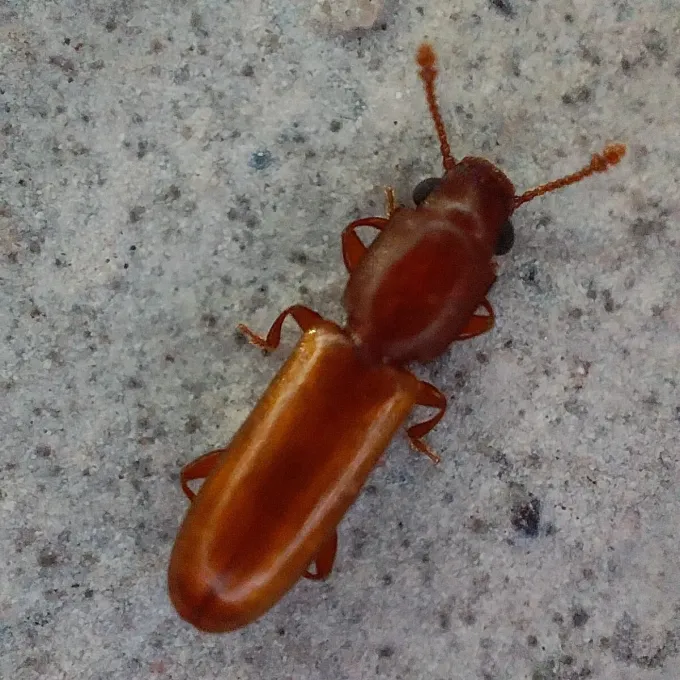
The square-necked grain beetle (Cathartus quadricollis) belongs to the family Silvanidae. Adults are small, slender, and flattened insects, typically measuring 2.5–3.5 mm in length.
Their flattened body shape allows them to hide efficiently in the crevices of storage bins, packaging, and machinery used in grain handling.
They are characterized by a reddish-brown color and a distinctively shaped pronotum that has squarish corners, which gives the species its common name.
The antennae are relatively short with a distinct club at the tip, and the surface of the body is covered with fine punctures.
Larvae are elongate, creamy-white in color, and possess well-developed legs, making them active crawlers within the grain bulk.
What it damages
This beetle is a serious pest of stored products, particularly in warmer climates where it can thrive year-round.
It infests a wide range of stored materials, including wheat, corn, rice, barley, and various processed grain products like flour and bran.
Besides cereals, it often attacks oilseeds, dried fruits, tree nuts, and occasionally tobacco, causing significant weight loss.
The damage is primarily caused by both larvae and adults feeding on the germ of the grain, which drastically reduces germination rates.
Large infestations lead to product contamination with waste, cast skins, and webbing, making the grains unsaleable for human consumption.
When it appears
The development of the square-necked grain beetle is highly dependent on ambient temperature and moisture levels within the facility.
The ideal conditions for rapid population growth include temperatures between 25°C and 30°C and a high relative humidity.
In temperature-controlled or continuously heated warehouses, the life cycle is completed in a short period, leading to overlapping generations.
Below 15°C, the metabolic activity and reproduction of the beetles significantly decrease, hindering their ability to cause large-scale damage.
Survival during cold periods is achieved by overwintering as adults in protected micro-habitats within the storage structure.
Signs of infestation
Visual identification of adults on the surface of grain piles or near warehouse structures is the primary indicator of an infestation.
The presence of fine powder or dust created by the feeding activities of larvae is a clear sign of a significant infestation level.
The formation of clumps or mats in flour or processed grains, bound together by larval secretions, is another common symptom.
An increase in the internal temperature of the grain mass (hot spots) often indicates the presence of an active pest colony.
Samples taken from various depths of the grain bulk and screened for insect presence are essential for accurate monitoring.
Control measures
Good warehouse hygiene is the first line of defense, involving the removal of old grain residues and dust where pests hide.
Maintaining grain moisture content below 13% is crucial, as this prevents the successful development of most storage beetle larvae.
Aeration systems should be used to lower the temperature of the grain bulk, as cooler conditions effectively stop reproduction.
In cases of severe infestation, fumigation with registered phosphine-based products is required to eliminate the pest population.
- Sanitation of empty silos and storage areas.
- Use of pheromone traps for regular monitoring.
- Implementing the First-In-First-Out (FIFO) stock management.
- Effective sealing of storage facilities.
Taxonomy
- Latin name
- Cathartus quadricollis
- Order
- Coleoptera (beetles)
- Family
- Silvanidae
- EPPO code
- CATHQU
Discussion
No discussions yet — be the first.