
Foreign grain beetle
Ahasverus advena
Description
How to identify
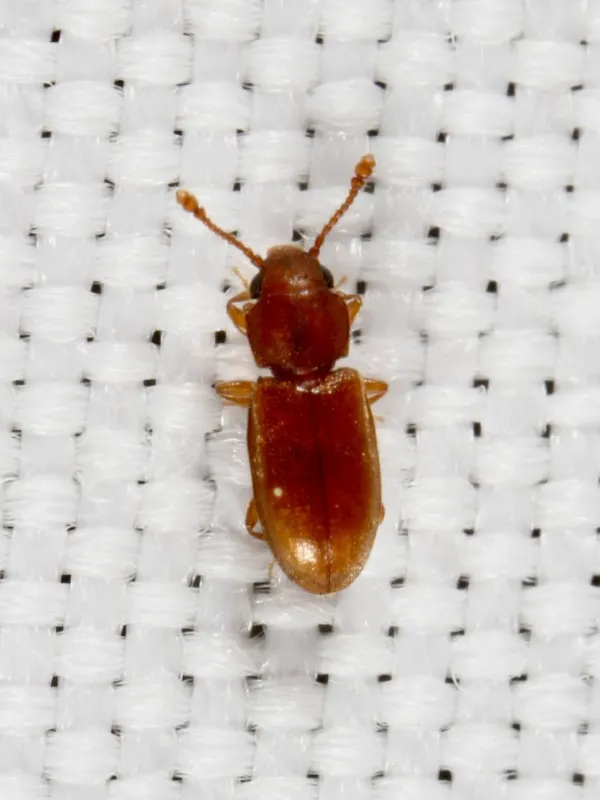
The foreign grain beetle (Ahasverus advena) is a small insect belonging to the Silvanidae family. An adult specimen typically measures between 2 and 3 millimeters in length and has an elongated, flattened body.
The coloration of the beetle ranges from reddish-brown to dark brown. A distinctive morphological feature is the slightly protruding corners of the pronotum, which gives the beetle its characteristic flattened appearance, allowing it to hide in narrow crevices.
The larvae are yellowish-white and small in size. They are highly mobile and possess strong mouthparts, enabling them to actively feed on substrate material during their early developmental stages.
Adult beetles are capable of flight, which greatly aids their dispersal between storage facilities. In warm environments, these insects remain active year-round, making complete eradication difficult without stringent control measures.
Identification can be confirmed by examining the microscopic structure of the pronotum and the form of the antennae, which feature a distinct club at the end, common among members of this family.
What it damages
This pest is a typical inhabitant of storage facilities, primarily attacking stored agricultural commodities. Oilseeds, grain products, and processed food items are at the highest risk of infestation.
The foreign grain beetle is most commonly found in damp grain or flour. The pest prefers to feed on moldy plant residues, making its presence a primary indicator of improper storage conditions.
Beyond oilseeds, the beetle can damage nuts, dried fruits, various cereals, and even tobacco. It is generally considered a secondary pest, meaning it prefers feeding on grain that is already damaged or moldy rather than healthy, intact seeds.
The presence of this beetle significantly reduces the market value of the stored crop. Infested grain loses its germination potential, develops a musty odor, and becomes unfit for food processing.
The pest facilitates the spread of fungal spores within the grain bulk, leading to hotspots of self-heating. This triggers a cycle of secondary damage that leads to substantial volume losses of the harvested crop.
When it appears
In storage conditions, the foreign grain beetle can reproduce continuously as long as the temperature is maintained above 15–18 degrees Celsius. The optimal conditions for population growth include moisture levels above 12–14%.
During the summer months, mass reproduction is observed in storage facilities. A full generation can develop in 3 to 4 weeks, depending on the microclimate, allowing the population to increase exponentially.
In unheated warehouses, insect activity drops significantly during winter, though they can survive cold spells in sheltered areas, such as floor cracks, behind wall panels, or within grain residues.
Infestations in the field prior to harvest are rarely recorded. Typically, contamination occurs during the transfer into storage or through contact with infested containers and transport equipment.
Monitoring should be conducted year-round, with increased vigilance during the harvest intake period when temperature conditions are most favorable for pest migration and colonization.
Signs of infestation
The primary sign of an infestation is the visual detection of adult beetles on the surface of the grain mass or inside it. These pests often aggregate in areas where localized moisture levels have increased.
A characteristic signal is the appearance of a musty, moldy odor in the facility, accompanied by visible fungal growth. The beetles are often found in association with this microflora, feeding on the mold.
When inspecting the grain bulk, fine excrement and dust resulting from larval activity may be observed. Unlike other pests, the foreign grain beetle leaves subtle signs of activity that are difficult to notice without magnification.
If sieved grain samples show damaged seeds with fungal coating, it is a strong indicator of the presence of Ahasverus advena.
- Increased temperature inside the grain bulk (self-heating hotspots).
- Presence of webbing or clumped particles of flour/grain.
- Visual presence of beetles during routine equipment inspections.
Control measures
The primary defensive measure is strict adherence to sanitary standards in storage facilities. Regular cleaning of floors, walls, and transport equipment to remove grain residues is essential.
An effective control method is the maintenance of low moisture levels in the grain mass (below 13%). In a dry environment, the development of foreign grain beetle larvae is significantly inhibited or stopped entirely.
Chemical control measures include the fumigation of facilities and grain products with approved phosphine-based preparations. This effectively eliminates pests at all stages of development, including hidden forms.
Applying insecticidal treatments to floor and wall surfaces (wet disinfestation) prior to the arrival of the new harvest helps prevent initial colonization from the external environment.
It is crucial to conduct regular temperature monitoring of the grain mass. Upon discovering the first signs of self-heating, the grain should be turned and dried immediately, followed by localized insecticide treatment if necessary.
Taxonomy
- Latin name
- Ahasverus advena
- Order
- Coleoptera (beetles)
- Family
- Silvanidae
- EPPO code
- AHASAD
Discussion
No discussions yet — be the first.