
Aegoschema modesta longhorn beetle
Aegoschema modesta
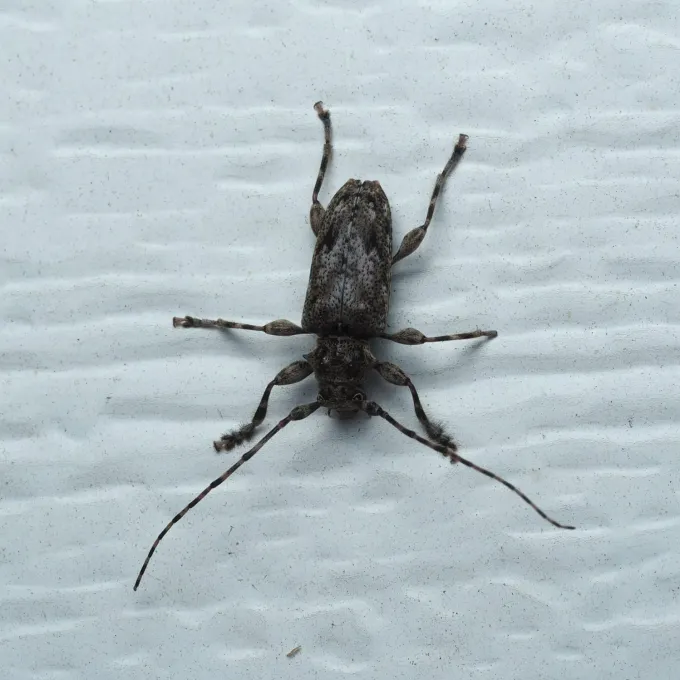
Description
How to identify
The Aegoschema modesta is a species of longhorn beetle (family Cerambycidae) known for its role in wood degradation. Like other members of the Lamiinae subfamily, it possesses distinctive long antennae and a robust body structure adapted for boring into wood.
Their coloration is typically cryptic, consisting of greyish or brownish patterns that provide excellent camouflage against the bark of host trees. This physical adaptation makes them notoriously difficult to detect by sight during their active life stage.
Larvae are legless, cylindrical, and cream-colored, featuring a highly sclerotized head capsule with powerful mandibles. These anatomical traits are specifically designed for efficient tunnel construction within dense wood tissues.
Females lay eggs in bark crevices or notches specifically created for protection. This strategic placement ensures that larvae have immediate access to nutrient-rich cambium upon hatching.
The pupal stage occurs within a chamber created inside the wood. Here, the metamorphosis from larva to adult is completed before the beetle bores its way to the surface to emerge.
##damage##This beetle primarily targets deciduous trees, showing a preference for weakened, stressed, or recently fallen wood. It is recognized as a secondary pest that significantly impacts tree health in forest ecosystems.
Larvae bore extensive, winding galleries through the phloem and sapwood. This internal tunneling disrupts the tree's vascular system, preventing the transport of water and essential nutrients to the canopy.
The damage caused by Aegoschema modesta is not limited to the tunnels themselves; they also facilitate the entry of fungal pathogens and wood-decay organisms, which can lead to rapid decay.
High populations of this beetle can build up in areas with large amounts of logging residue or storm-damaged timber, creating an increased risk for surrounding healthy trees.
Long-term infestation often results in stunted growth, branch dieback, and eventually the structural failure of the tree, rendering the timber worthless.
##season##Adult beetles are typically active during the warm summer months. This period is critical for mating and the selection of suitable host trees for oviposition.
The beetles are predominantly nocturnal or crepuscular, often remaining hidden in the canopy during the brightest parts of the day to avoid avian predators.
The developmental cycle of this species can extend over multiple years, depending heavily on the nutritional quality of the wood and the prevailing climatic conditions.
Larval activity continues throughout the year, although the rate of development slows significantly during colder winter months when metabolic activity is reduced.
Spring and summer are the most critical seasons for monitoring, as this is when the beetles emerge and begin their reproductive cycle, increasing the likelihood of fresh infestation.
##signs##A primary indicator of Aegoschema modesta presence is the appearance of exit holes on the tree trunk. These holes are typically oval or circular in shape.
Frass—a mixture of wood dust and excrement—often accumulates at the base of the tree or in bark fissures near the exit holes. This is a tell-tale sign of active larval boring inside the wood.
Visual symptoms on the tree canopy include premature yellowing of leaves, branch dieback, and a generally sparse or chlorotic foliage appearance.
- Oval-shaped exit holes on bark
- Accumulation of wood frass at the base
- Dieback of upper branches
- Localised bark discoloration or peeling
- Presence of beetles on the trunk during summer
Removing a section of the outer bark often reveals the presence of tunnels filled with frass, which provides definitive proof of an established infestation.
##control##The most effective management strategy involves rigorous sanitation, including the prompt removal and destruction of infested or wind-felled trees from the area.
Avoiding the accumulation of logging debris is essential, as these materials provide optimal breeding grounds for the beetle population to thrive and spread.
Pheromone traps can be deployed during the adult flight period to monitor population densities and identify the necessity for further intervention.
For high-value ornamental trees, systemic insecticides can be applied to the trunk during the pre-emergence window to prevent new colonization by adults.
Maintaining tree vigor through proper silvicultural practices, including sufficient irrigation and protection from physical wounds, is the best preventive measure against wood-boring pests.
[SOURCE] -Taxonomy
- Latin name
- Aegoschema modesta
- Order
- Coleoptera (beetles)
- Family
- Cerambycidae
- EPPO code
- ACADDE
Discussion
No discussions yet — be the first.