
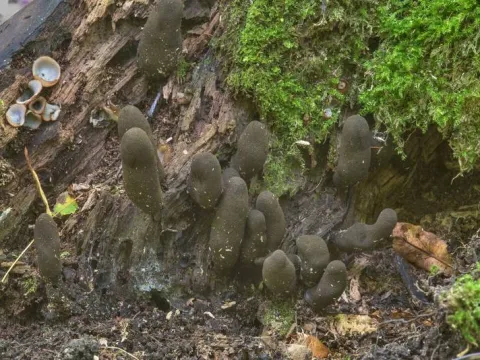
Xylaria polymorpha
Xylaria polymorpha
Xylaria polymorpha, commonly known as Dead Man's Fingers, belongs to the kingdom Fungi, phylum Ascomycota, and family Xylariaceae. It is a distinctive wood-decay fungus recognized by its unique morphological structure.
What the section contains
Xylaria polymorpha
The fruiting bodies are club-shaped, cylindrical, or irregularly branched, often reaching 3 to 10 cm in height. Initially, they are light-colored, but they eventually turn black, hard, and wrinkled, resembling human fingers emerging from the ground or wood.
Inside, the fruiting body consists of a white, dense mass of fungal tissue. The fungus primarily acts as a saprophyte, but it can turn into a facultative parasite, attacking the heartwood and sapwood of weakened trees.
The species is widely distributed in temperate regions. It reproduces through ascospores contained within perithecia embedded in the outer layer of the fruiting body, which are released into the air.
The mycelium of Xylaria polymorpha is highly resilient and can colonize large volumes of wood, maintaining its metabolic activity even under fluctuating environmental conditions.
The host range of this pathogen includes various broad-leaved trees such as beech, oak, maple, apple, and pear. It typically attacks trees that are already stressed, damaged, or decaying.
It causes white rot, a type of wood decay where the fungus breaks down both lignin and cellulose. This process significantly reduces the structural integrity of the tree, leading to soft, pulpy wood.
Infection usually enters the host through pruning wounds, frost cracks, or sunscalds on the bark. Once inside, the mycelium spreads, colonizing the wood tissues and expanding the necrotic zone.
The damage is cumulative. As the fungus consumes the wood, the tree loses its mechanical strength, increasing the risk of trunk failure, limb breakage, and eventual death of the specimen.
In managed orchards or landscapes, infected trees become hazardous. They serve as a reservoir for spores, potentially threatening neighboring healthy trees if not properly removed.
The fruiting bodies typically appear during the summer and autumn months, from June to October. This is the period when the fungus is most visible on the surface of the bark or around the base of the trunk.
Spore release is facilitated by high humidity and rainfall. The spores are then dispersed by wind and splashing water to colonize new entry points on damaged wood surfaces.
During the winter, the fungus remains in a dormant vegetative state within the wood. It does not die but waits for favorable conditions to resume its growth and colonize further tissues.
The spring season represents a critical window for infection. As trees begin their growth cycle and suffer from potential winter damage, the open wounds become entry points for the pathogen.
Environmental factors like persistent dampness and lack of sunlight promote the development of Xylaria polymorpha. Well-aerated and sunny garden sites are generally less prone to severe infestations.
The primary sign of infection is the emergence of black, finger-like fruiting bodies on the bark or at the root collar. These often appear in clusters and are very hard to the touch.
Underneath the bark, one might observe a white, fan-like mycelial mat. The wood itself, when exposed, often displays distinct dark lines (zone lines) that mark the boundaries of fungal decay.
General signs of tree distress, such as leaf yellowing, thinning canopy, or branch dieback, may indicate that the fungus has reached the tree's vascular system or is compromising the roots.
Hollowed-out trunks or internal cavities are classic signs of long-term Xylaria activity. In such cases, the wood is brittle and easily crumbled into a spongy, white substance.
- Clusters of black, club-like growths on trunks.
- White mycelial growth visible under loose bark.
- Internal wood discoloration and spongy texture.
- Formation of hollows and increased wood fragility.
- Premature leaf drop and limb dieback.
Control of Xylaria polymorpha is challenging because the pathogen exists primarily inside the tree. Therefore, management focuses on prevention, sanitation, and maintaining tree vigor.
Regular sanitary pruning is essential. All dead or diseased wood must be removed, and pruning tools should be disinfected with alcohol or copper-based solutions between trees to prevent spore transfer.
Any large wounds or cuts must be protected immediately with wound dressings or specialized antiseptic paints to create a physical barrier against airborne spores.
If a tree is severely infected, it should be removed, including the root system. Leaving an infested stump or large roots in the ground maintains the pathogen in the environment.
Promoting tree health through proper fertilization, irrigation, and avoiding physical damage to the trunk increases the tree's natural defense mechanisms, making it less susceptible to colonization.