
Xylophilus ampelinus
Xylophilus ampelinus
Xylophilus ampelinus is a Gram-negative, aerobic, non-spore-forming bacterium that belongs to the family Comamonadaceae. It is the causal agent of bacterial necrosis, also known as bacterial blight or 'Maladie d'Oléron' in grapes.
What the section contains
Xylophilus ampelinus
The pathogen is highly specialized for grapevine hosts. It is a systemic vascular bacterium that colonizes the xylem vessels, where it multiplies and produces extracellular polysaccharides, leading to the occlusion of the water-conducting tissues.
Transmission primarily occurs through infected propagation material. Because the bacteria can reside in the wood of asymptomatic vines, it is easily spread globally through international trade of grape cuttings and rootstocks.
Environmental conditions play a crucial role in the development of the disease. High humidity and cool temperatures during the spring budding period provide the most favorable environment for the activation and spread of the pathogen within the plant.
The bacteria can survive in woody tissues for years, remaining latent until environmental triggers or plant physiological status allow for more aggressive symptom development, making it a persistent threat to vineyards.
The disease primarily affects Vitis vinifera and various hybrid grape varieties. The impact is systemic, damaging both young succulent shoots and perennial wood, eventually compromising the overall health of the grapevine.
Infection results in the stunting of vine growth and a significant reduction in leaf surface area, which negatively affects the plant's ability to perform photosynthesis and store nutrients for the following season.
Fruit production is severely impacted as the bacteria cause necrosis in the inflorescences and stems. This leads to the drying of clusters, premature fruit drop, and, in severe cases, the complete loss of the annual harvest.
Over time, the structural integrity of the vine is lost. The necrosis of the wood makes the canes brittle, causing them to break under wind pressure or the weight of the canopy, requiring extensive pruning or even total vine removal.
The economic impact is substantial, as it leads to decreased yields, poor fruit quality, and increased management costs, often forcing growers to remove entire vineyard blocks to stop the spread of the infection.
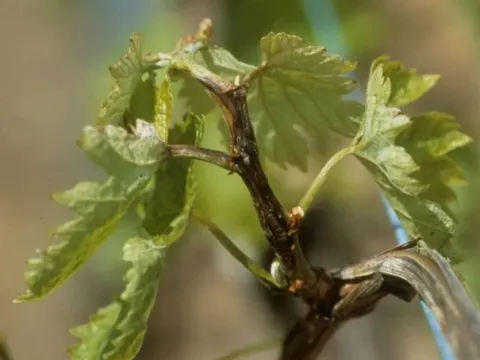
Early symptoms often appear in the spring when the vines start to grow. Infected shoots may show dark, longitudinal lesions or cracks, which later develop into deep, necrotic cankers that can girdle the shoot.
Leaf symptoms include small, angular, dark-brown or black spots with a yellow halo. These lesions may merge, causing leaves to become distorted or drop prematurely during the summer months.
A classic sign is the sudden wilting and drying of entire shoots or canes, which may resemble cold damage but occurs during the active growing season. This symptom is often referred to as 'shoot dieback'.
- Development of necrotic cankers on current-season and older wood.
- Bacterial ooze appearing on the surface of infected lesions during humid conditions.
- Desiccation of inflorescences leading to blossom blight.
- Brown discoloration of the vascular tissues visible on cross-sections of stems.
If a cross-section is made of an infected stem, one will observe a distinct brown or darkened ring within the vascular tissues, which serves as a key indicator of the bacterial colonization of the xylem.
The primary control strategy is the use of healthy, certified, disease-free nursery stock. Stringent quarantine protocols and nursery certifications are essential to prevent the introduction of Xylophilus ampelinus into new areas.
Sanitation is critical in established vineyards. Pruning tools must be disinfected with appropriate sanitizing agents, such as bleach or high-concentration alcohol, after use on each individual vine to avoid mechanical transmission.
Chemical control remains limited; however, preventive applications of copper-based bactericides during the dormant season and immediately after pruning can help reduce the bacterial population on the surface of the vines.
Effective management includes the timely identification and removal of symptomatic vines. Infected plants should be uprooted, including as much of the root system as possible, and destroyed by burning to eliminate reservoirs of the pathogen.
Minimizing physical damage to the vines during canopy management and harvesting is recommended, as any open wound serves as an entry point for the bacteria to infect the vascular system of the grapevine.