
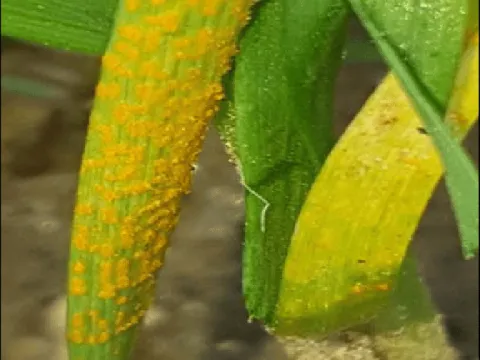
Yellow rust
Puccinia glumarum
Yellow rust, caused by the fungus Puccinia striiformis (often referred to as stripe rust), is a significant obligate biotroph that affects cereal crops. It belongs to the Basidiomycota division and is characterized by its high specialization to host tissues, living strictly on live plant cells.
What the section contains
Yellow rust
The pathogen is known for its ability to produce specialized forms (f. sp.) adapted to specific hosts such as wheat, barley, and various grasses. This genetic variability leads to the constant emergence of new, more aggressive races, which remains a primary challenge for resistance breeding programs worldwide.
The life cycle of the pathogen centers around the production of urediniospores, which are responsible for the rapid spread of the disease during the growing season. Teliospores are typically produced later in the cycle or under environmental stress, serving as the survival stage.
The fungus overwinters as mycelium in the tissues of winter cereals or on volunteer plants, acting as a "green bridge." When favorable conditions return, it produces fresh spores that initiate new infection cycles in early spring.
Microscopic identification is based on the morphology of urediniospores, which are gold-yellow and form in linear patterns. These spores rupture the epidermis, creating the characteristic visual symptoms seen on the foliage of infected plants.
Yellow rust predominantly infects wheat, but can also damage barley, rye, and several wild grass species. It is particularly devastating in cool, temperate climates where high humidity promotes rapid infection cycles and mass spore dispersion.
The pathogen attacks all green parts of the plant, including leaves, sheaths, stems, and glumes. When the head is infected, it can lead to shriveled grains, which severely affects both the yield quantity and the overall quality of the harvest.
By consuming nutrients and disrupting photosynthetic activity, the fungus causes premature leaf senescence and death. This depletion of resources significantly hampers the plant's ability to fill the grain, leading to a marked reduction in thousand-kernel weight.
Economic losses due to yellow rust can be severe, with potential yield reductions of 50-70% in highly susceptible varieties under epidemic conditions. Beyond yield loss, it impacts grain grading, flour quality, and the overall vigor of seeds intended for future planting.
Infected crops are also more susceptible to secondary stressors, including drought and other pathogens, leading to an overall decline in plant health and structural integrity across the entire field.
Yellow rust is a disease of cool, wet weather. The optimal temperature for spore germination and infection ranges from 9°C to 15°C. High atmospheric humidity, morning dews, and frequent light rain are critical drivers of epidemic outbreaks.
Symptoms are typically first observed in early spring as soon as winter crops resume growth. Infection continues to spread until temperatures consistently exceed 20°C, which slows the fungal metabolism and halts the rapid development of new pustules.
Spore dispersal occurs primarily via wind, allowing the pathogen to travel long distances. Urediniospores can remain viable in the upper atmosphere, facilitating the rapid regional spread of the disease and enabling large-scale epidemics across wide geographical areas.
Secondary infection cycles repeat every 7 to 14 days, depending on environmental favorability and host resistance levels. This multiplicative potential allows the pathogen to reach epidemic levels quickly if the weather remains cool and moist for extended periods.
Overwintering occurs as mycelium within the leaves of winter cereals. Volunteer plants that sprout after the harvest serve as essential reservoirs, bridging the gap between seasons and providing an early source of inoculum for the next crop.
The most distinctive sign of yellow rust is the appearance of bright yellow or orange pustules arranged in clear, parallel rows along the leaf veins. This organized pattern is why the disease is commonly called "stripe rust."
As the infection matures, these pustules coalesce into long streaks running the length of the leaf blade. In severe cases, the leaf surface can become almost entirely covered with yellow spore masses, significantly reducing the green area available for photosynthesis.
Toward the end of the season, black telia may appear, often covered by the host epidermis. This transition indicates that the fungus has moved into a more dormant phase or is completing its biological cycle, contrasting with the active yellow uredinial stage.
Early-stage infections may present as small, scattered spots that are easily overlooked. However, as the disease progresses, yellow chlorosis and subsequent necrosis become prominent, eventually leading to leaf curling and tissue death.
Plants affected by yellow rust appear stunted and prematurely aged. In high-pressure scenarios, the entire canopy of the field may take on a yellowed, unhealthy appearance, signaling a severe decline in plant vigor and overall yield potential.
The primary control strategy is the use of genetically resistant cultivars. However, because the fungus is highly adaptive and evolves new races, resistance genes can be overcome, requiring a dynamic and integrated approach to disease management.
Cultural practices are vital to breaking the disease cycle. This includes the destruction of volunteer plants and cereal "green bridges" after harvest, as well as managing seeding dates to avoid early autumn infection of winter crops.
- Regular field scouting to monitor for the first signs of infection.
- Application of triazole or strobilurin-based fungicides when thresholds are met.
- Balanced nutrient management to avoid excessive nitrogen, which can create dense, succulent canopies.
- Use of crop rotation to reduce inoculum build-up in the soil and crop debris.
Chemical control is most effective when applied preventatively or at the very onset of symptoms. Modern systemic fungicides provide protective and curative activity, shielding new growth from secondary infections and limiting the spread of the pathogen.
An integrated pest management (IPM) approach, combining diligent monitoring, resistant varieties, and judicious use of fungicides, is the most sustainable method for minimizing crop losses and maintaining high productivity in grain production.