
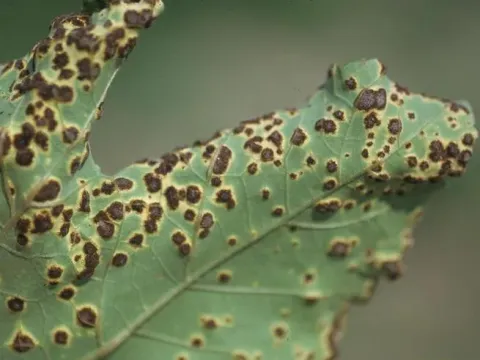
Xanthium rust
Puccinia xanthii
Puccinia xanthii, commonly known as the Xanthium rust fungus, is an obligate parasitic fungus within the order Pucciniales. This pathogen is highly host-specific, primarily targeting species within the Xanthium genus, commonly referred to as cockleburs.
What the section contains
Xanthium rust
As a microcyclic rust fungus, Puccinia xanthii completes its life cycle on a single host. It lacks the complex alternation of hosts typical of other rust fungi, making it a specialized pathogen adapted to the phenology of its host plant.
Taxonomically, it belongs to the Basidiomycota division. The fungus exists as an intercellular mycelium that derives nutrition directly from living plant cells, which defines its role as a biotrophic organism incapable of saprophytic growth.
The fungus is characterized by the production of teliospores, which are the primary reproductive and survival structures. These spores are capable of withstanding various environmental stressors, ensuring the persistence of the pathogen in the ecosystem.
Due to its high level of host specificity, Puccinia xanthii has been the subject of extensive scientific research as a potential biological control agent for invasive cocklebur species in various agricultural and natural landscapes.
The primary host of Puccinia xanthii is Xanthium strumarium. The fungus infects leaves, stems, and the burs of the plant, systematically weakening the host throughout its development.
The main form of damage is the reduction of the photosynthetic surface area. As the fungus consumes plant nutrients, the host plant experiences stunted growth, reduced vigor, and a decreased ability to compete with other flora.
Severe infections often lead to premature leaf drop, which disrupts the energy balance of the weed. By limiting the growth of vegetative tissues, the fungus effectively prevents the plant from reaching its full reproductive potential.
The infection of the burs is particularly significant, as it interferes with seed development and viability. This suppression of the reproductive cycle is a crucial factor in reducing the long-term weed seed bank in infested soils.
While detrimental to the host weed, the pathogen causes no harm to economically important crops, as its host range is strictly limited to members of the Asteraceae family, specifically the genus Xanthium.
Infection is first recognized by the appearance of small, chlorotic spots on the upper leaf surfaces. These spots are the initial manifestation of the underlying fungal colonization of the leaf mesophyll.
On the underside of the leaves, the pathogen develops characteristic pustules known as telia. These structures are initially brown, eventually turning darker or black as the mass of teliospores matures.
As the disease progresses, the leaf tissues around the pustules become necrotic and dry. In cases of systemic infection, the entire plant may show signs of yellowing, wilting, and deformation, particularly in younger, more actively growing tissues.
The presence of spore masses on the leaves is a definitive diagnostic sign of Puccinia xanthii. Under high humidity, these spores can be seen as a fine, powdery coating, which is easily dispersed by wind and splashing rain.
The rapid spread of the disease across the host plant population is often facilitated by favorable microclimatic conditions, specifically prolonged periods of leaf wetness and moderate to high temperatures.
In the context of biological weed management, Puccinia xanthii is encouraged as a natural suppressor of cocklebur populations. Optimal conditions for spread include high relative humidity, which is essential for spore germination.
If the fungus needs to be controlled or suppressed, systemic fungicides, particularly those containing triazoles or strobilurins, are highly effective. These chemicals disrupt the fungal metabolic processes and inhibit the development of pustules.
Cultural control practices focus on the sanitation of the field. Tillage operations that bury crop and weed residues help in the decomposition of infected plant material, thereby reducing the survival rate of the fungal spores.
Research into mycoherbicides involves the formulation and application of Puccinia xanthii spores. This method aims to accelerate the natural onset of the disease in weed-infested areas, providing an eco-friendly alternative to chemical herbicides.
Integrated pest management strategies utilize monitoring to assess the prevalence of the rust. By understanding the infection dynamics, farmers can make informed decisions regarding the timing of mechanical or chemical interventions.