
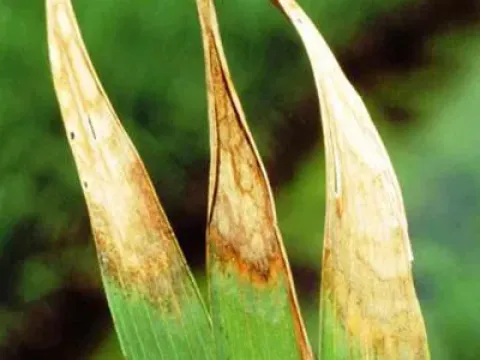
Rice leaf scald
Rhynchosporium oryzae
The causative agent of rice leaf scald is the fungus Rhynchosporium oryzae. It is a fungal pathogen belonging to the Ascomycota division, known for affecting rice plants in various growing regions worldwide.
What the section contains
Rice leaf scald
The fungus survives primarily in crop residues and can be disseminated by wind, irrigation water, and rain splash, which facilitates its spread across rice fields.
The pathogen initiates infection when conidia land on susceptible leaves, germinating under conditions of high humidity and moderate temperatures typically found in the crop canopy.
As the fungus colonizes the leaf tissue, it develops an extensive mycelial network, eventually leading to the formation of characteristic necrotic spots that disrupt the host's normal physiology.
Research into the life cycle of Rhynchosporium oryzae emphasizes that effective management must target both the initial primary inoculum and the secondary spread during the growing season.
The disease primarily attacks Oryza sativa, causing significant reductions in photosynthetic capacity due to the death of green leaf tissues.
The lesions caused by the fungus decrease the amount of available energy for grain filling, leading to smaller, shriveled kernels and overall weight loss per panicle.
High levels of infection can cause extensive leaf necrosis, which interferes with plant vigor and can lead to significant yield losses in susceptible varieties.
Beyond quantity, the infection often impacts the quality and milling yield of the rice grain, resulting in economic disadvantages for farmers and producers.
Severely damaged plants are often predisposed to secondary infections by other opportunistic pathogens, creating a complex disease situation in the field.
Initial symptoms consist of small, water-soaked spots that rapidly expand into larger, oval or irregular necrotic lesions on the leaves.
A distinctive feature of these lesions is the presence of concentric zones and dark borders, which distinguish them from other common rice leaf spot diseases.
The center of the lesions typically turns greyish-white as the tissue dies, while the edges remain dark brown, reflecting the advancing front of the fungal infection.
In highly humid conditions, a sparse, greyish fungal growth may be visible on the surface of the lesions, representing the massive production of fungal conidia.
The infection usually starts from the leaf tip or margins, progressing downwards until the entire leaf turns chlorotic and eventually dries up.
Cultivation of resistant or tolerant rice varieties is the primary strategy for managing leaf scald, as it minimizes the need for chemical interventions.
Integrated pest management (IPM) practices, including proper crop rotation and the removal or incorporation of infected debris, help to reduce the primary inoculum load.
Balanced fertilization, particularly avoiding excessive nitrogen rates, is crucial as lush, dense foliage creates an environment favorable for rapid fungal development.
Chemical control using systemic fungicides should be applied preventively or at the earliest onset of symptoms to stop the secondary spread of the pathogen.
Field water management, such as timely drainage, can help modulate the microclimate within the canopy, making conditions less conducive to the pathogen's development.