
Rice sheath blight
Rhizoctonia oryzae
Rice sheath blight is caused by the soil-borne fungal pathogen Rhizoctonia oryzae. It belongs to the Basidiomycota phylum and is characterized by its ability to produce sclerotia, which act as the primary survival structures in the soil and crop debris.
What the section contains
Rice sheath blight
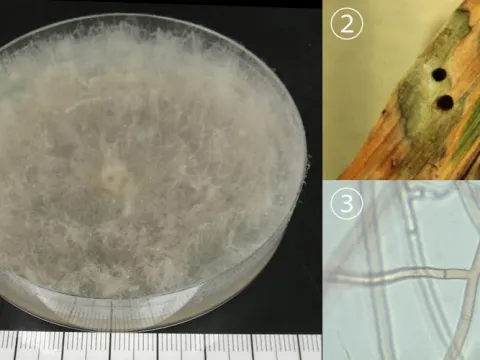
The pathogen does not produce conidia; instead, it spreads through vegetative mycelial growth. Under the microscope, the hyphae exhibit characteristic right-angle branching and a constriction at the base of the branches, which is diagnostic for the genus.
Sclerotia of Rhizoctonia oryzae are irregular, initially white, and eventually darken to brown or black. These structures can survive in harsh environmental conditions for extended periods, making the pathogen difficult to eradicate from infected fields.
Infection primarily occurs via mycelial colonization. The fungus thrives in humid conditions and spreads rapidly through the irrigation water used in paddy fields, facilitating the movement of the pathogen between rice stools.
This pathogen is considered a major limiting factor in high-yielding rice production systems worldwide, especially in tropical and subtropical regions where environmental conditions favor its development.
The primary host for this fungus is rice (Oryza sativa). The disease attacks the leaf sheaths and stems, particularly the parts of the plant near the water level in the paddy field.
As the infection progresses, it disrupts the plant's vascular system, leading to impaired translocation of nutrients and water. This results in significant yield losses, including reduced grain filling and poor grain quality.
In cases of severe infection, the stems become weakened, causing the plants to lodge (fall over). This not only reduces the overall harvest but also creates significant difficulties during mechanical harvesting processes.
Yield losses due to rice sheath blight can vary widely, but in epidemic years, they can reach 25% or more if not managed properly. The disease affects the photosynthetically active leaf area, leading to plant death in severe cases.
Alternative hosts, such as various grassy weeds, can harbor the pathogen in and around rice fields, providing a continuous source of inoculum for subsequent cropping seasons.
The disease is most prevalent during the rice growing season, typically starting from the tillering stage. It intensifies as the canopy closes and humidity within the crop increases.
Warm temperatures, ranging from 25°C to 30°C, combined with high humidity, are optimal for the growth of Rhizoctonia oryzae. Frequent rains and overcast skies significantly promote the spread of the infection.
Inundated paddy fields provide the ideal environment for the fungus to grow. The mycelium can easily travel through the standing water to infect neighboring healthy plants, leading to a rapid expansion of the infected area.
The disease cycle usually begins when sclerotia float to the water surface or germinate in the soil, coming into contact with the lower leaf sheaths of the rice plants.
Late-season outbreaks are often more destructive as they coincide with the critical reproductive phases of the rice crop, thereby directly impacting the formation and filling of the panicles.
The first signs of rice sheath blight appear as small, oval, or elliptical spots on the leaf sheaths near the water line. These lesions have a dark brown or reddish-brown border and a lighter, necrotic center.
Under humid conditions, a white or grayish mycelial mat may be visible on the surface of the lesions. As the fungus matures, it produces numerous small, irregular sclerotia within the mycelial mat.
As the disease progresses, lesions enlarge and coalesce, eventually covering large portions of the leaf sheath and potentially reaching the stem. This causes the leaves to yellow, wither, and eventually die prematurely.
Stems infected by the pathogen become brittle, which can be observed by pulling the stems gently. The presence of these lesions and the characteristic web-like mycelium are key indicators for identifying the disease in the field.
- Oval-shaped brown lesions on leaf sheaths.
- White web-like mycelial growth on affected parts.
- Development of dark, irregular sclerotia.
- Premature yellowing and death of the lower foliage.
- Stunting and panicle blanking (poor grain filling).
Effective management starts with cultural practices. Crop rotation with non-host crops is crucial for reducing the survival of sclerotia in the soil, which helps lower the overall disease pressure in the field.
Water management plays a key role; avoiding excessive water depth helps prevent the easy spread of the pathogen. Proper leveling of fields ensures uniform water distribution and limits pockets of infection.
Sanitation is equally important: removing weeds and deep plowing after harvest helps bury crop residues and sclerotia, reducing the initial inoculum for the next season. Burning stubble is sometimes practiced but must comply with local regulations.
Breeding and planting resistant rice varieties is the most sustainable approach to controlling sheath blight. Many modern programs focus on developing cultivars with high resistance to fungal penetration and colonization.
Chemical control involving systemic fungicides (such as strobilurins or triazoles) can be effective. Applications should be timed correctly, often at the first appearance of symptoms, to maximize efficacy and minimize the development of resistance.