
Ramulispora leaf spot
Ramulispora
The pathogen belongs to the Fungi kingdom, genus Ramulispora. It is a specialized fungal pathogen responsible for various leaf spot diseases in cereal crops.
What the section contains
Ramulispora leaf spot
Microscopically, it is identified by the presence of dense clusters of conidiophores and spores, which are the primary reproductive structures of the fungus.
The fungus maintains its lifecycle by surviving on crop debris and in the soil, utilizing sclerotia or mycelium to endure cold seasons.
Taxonomically, it is often associated with other spot-causing fungi, requiring professional laboratory diagnostic tools for precise identification in complex field scenarios.
Dispersal is primarily facilitated by wind and rain splash, allowing the fungus to spread rapidly across dense crop canopies under suitable conditions.
Cereal crops, including wheat, barley, rye, and oats, are the primary hosts of the pathogen, suffering significant damage during high-pressure years.
The disease causes substantial loss of photosynthetic leaf area, which directly impairs the grain filling process and leads to reduced kernel weight.
Heavy infection causes the premature death of lower leaves, which limits the plant's ability to maintain energy reserves during critical development stages.
Structural integrity of the stems can be compromised, leading to stem breakage and lodging, which makes the crop difficult to harvest mechanically.
The overall quality of the grain is often downgraded due to poor development, resulting in economic losses for farmers and reduced value in the market.
The disease cycle begins in early spring, triggered by moderate temperatures and the presence of moisture, which encourages the growth of the pathogen.
Infection starts from residues left in the field or from infected seeds, which serve as the initial source of the fungal inoculum for the season.
The peak of disease development typically occurs during the stem elongation and heading phases, supported by humid weather conditions.
Frequent rainfall episodes during the growing season serve as the primary mechanism for the upward spread of spores from the soil to the upper leaves.
As the season comes to an end, the fungus develops survival structures that remain in the soil, ready to infect the next cycle of plants.
The characteristic sign of the infection is the appearance of leaf spots with a distinct light-colored center and a dark brown or black margin.
Tiny black dots, representing the fungal sporodochia, often become visible within the necrotic spots under high-humidity conditions.
In severe infections, individual lesions coalesce to cover large areas of the leaf blade, causing yellowing and eventual tissue necrosis.
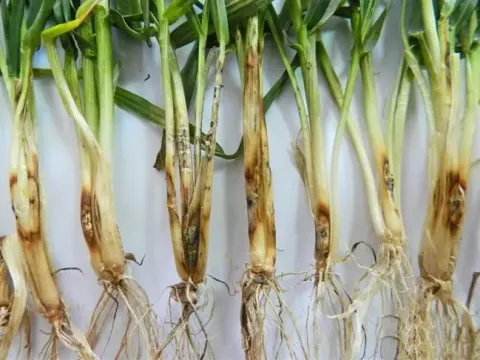
Stem infections manifest as dark, discolored areas that weaken the stalk and can lead to lodging if the infection is widespread.
- Light-colored spots with dark margins on leaves.
- Visible black fungal fruiting bodies within lesions.
- Widespread necrosis and premature leaf senescence.
- Weakening and potential lodging of the stem base.
Crop rotation is the most effective cultural practice to manage the pathogen, preventing the build-up of inoculum in the field.
Deep plowing and proper residue management are crucial to burying infested stubble and accelerating its decomposition.
Seed treatments with systemic fungicides are essential to protect the emerging seedlings from primary infections originating from the seeds.
Foliar application of fungicides during the active growth period is necessary when environmental conditions favor disease development.
Monitoring the field for early symptoms is vital to ensure that chemical control measures are applied before the disease spreads throughout the crop.