
Radish mosaic
Radish mosaic
The causative agent is the Radish mosaic virus (RMV), a member of the Comovirus genus within the Secoviridae family. It is a plant virus with single-stranded RNA and icosahedral particles.
What the section contains
Radish mosaic
The virus has a narrow host range, primarily infecting crops within the Brassicaceae family, including radish, turnip, and various types of cabbage or mustard.
It is not seed-transmitted. The primary method of spread in the field is through insect vectors, specifically leaf-feeding beetles, which carry the virus on their mouthparts.
Weeds belonging to the Brassicaceae family act as the primary natural reservoir, allowing the virus to survive throughout the winter and infect new crops in the spring.
Diagnosis requires laboratory confirmation using techniques such as ELISA (Enzyme-Linked Immunosorbent Assay) or RT-PCR to distinguish it from other viral pathogens.
Radish and other root crops in the Brassicaceae family are the most affected. Infection leads to stunted growth and poor development of the edible root part.
Early-season infections are particularly devastating, as they hinder the plant's ability to reach marketable size and quality during the short growing period.
In addition to root crops, the virus can affect seed production, causing malformation of flower stalks and a significant reduction in seed yield and viability.
Economic losses can be substantial, often ranging from 30% to 70% in highly infested fields, impacting the profitability of commercial vegetable operations.
The virus impacts the overall plant physiology, reducing photosynthetic efficiency and making the crop more susceptible to secondary stressors like drought or pests.
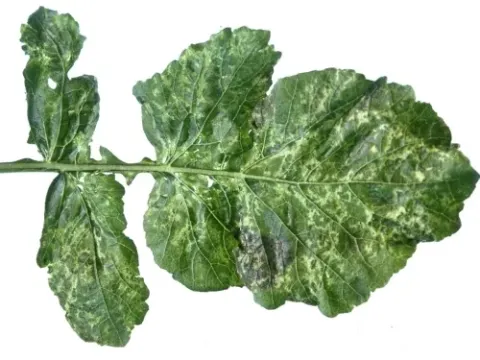
The classic symptom is a mosaic pattern on the leaves, characterized by alternating light green and dark green patches that often appear mottled.
Leaves may show severe distortion, curling, or puckering. In many cases, the leaf size is noticeably reduced compared to healthy specimens.
Root development is often impaired, resulting in undersized, deformed, or woody roots that are unsuitable for fresh market sale.
In severe infections, necrosis or chlorotic spots may develop on the foliage, leading to premature leaf drop and the potential collapse of the plant.
- Mottled, mosaic-like foliage.
- Leaf curling and deformation.
- Significant plant stunting.
- Poor root development.
Effective management focuses on breaking the infection cycle by controlling weed reservoirs in and around the agricultural fields.
Managing populations of leaf-feeding beetles (vectors) through appropriate insecticide applications is crucial to prevent the spread of the virus during the growing season.
Implementing rigorous farm hygiene practices, such as sanitizing equipment, helps prevent the mechanical transmission of the virus between infested and healthy plants.
Strategic planting dates and spatial isolation from older or symptomatic fields can significantly reduce the pressure of infection on new crops.
Selecting virus-resistant or tolerant cultivars is the most sustainable approach, combined with healthy seed and seedling management to avoid early exposure.