
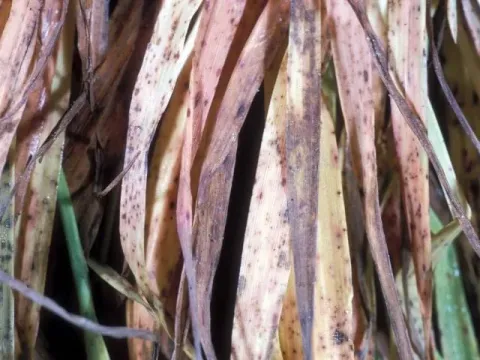
Pyrenophora leaf stripe of oats
Pyrenophora avenae
The disease is caused by the ascomycete fungus Pyrenophora avenae (anamorph Drechslera avenae). It is a major pathogen affecting oat crops worldwide, particularly in temperate regions with high moisture levels.
What the section contains
Pyrenophora leaf stripe of oats
The fungus survives as mycelium within infected seeds or as spores and pseudothecia on crop residues left in the field. This persistence makes it a recurring threat in agricultural systems where sanitation is poor.
Environmental conditions, specifically cool temperatures and high humidity, trigger the germination of conidia. These spores are then dispersed by wind and splashing rain, facilitating the spread of the disease to healthy plants.
The life cycle begins with primary infection from seed-borne inoculum or debris. Secondary infections occur throughout the growing season as the pathogen produces fresh crops of conidia on necrotic leaf tissue.
Because the fungus is highly adaptable, it can thrive under various climatic conditions, leading to persistent infection cycles if resistant varieties are not utilized or if rotation is neglected.
The pathogen impacts oats at all developmental stages, from seedling emergence to grain maturation. Early-season infections are particularly destructive, often resulting in seedling blight.
The primary damage involves the reduction of the green leaf area, which severely limits the photosynthetic capacity of the plants. This leads to stunted growth, lower biomass production, and reduced potential yield.
Leaf stripe causes significant thinning of the stand due to plant mortality and root rot. Fewer tillers survive to produce grain, directly lowering the overall harvest volume and profitability of the crop.
The quality of the grain is also compromised, as infected plants produce shriveled, lightweight seeds with poor germination rates and low test weight, making them unsuitable for seed lots.
Economic losses can be substantial, often ranging from 10% to 30% under epidemic conditions, where favorable weather promotes rapid secondary spread throughout the oat canopy.
Symptoms initially appear on seedlings as reddish-brown or dark brown streaks or elongated lesions. These lesions may be surrounded by a distinct chlorotic halo, indicating the plant's stress response.
A hallmark sign of the infection is the development of a greyish, velvety mycelial mat on the leaf surface. This represents the conidial sporulation of the fungus, usually occurring on the underside of leaves.
As the disease progresses, the striping effect becomes more pronounced, eventually leading to severe leaf yellowing and necrosis. The leaves often curl, shred, and wither prematurely under heavy infestation.
- Reddish-brown longitudinal stripes on young leaves.
- Velvety grey sporulation on lesion surfaces.
- Premature yellowing and senescence of the lower foliage.
- Darkening of panicles and grain surfaces during ripening.
When the infection reaches the panicle, dark, necrotic spots appear on the kernels, which not only ruins the visual quality of the harvest but also signifies the presence of the pathogen on the grain.
The most critical control measure is the use of high-quality, pathogen-free seeds. Seed testing for P. avenae infection should be standard practice before planting any oat crop.
Crop rotation is essential for breaking the infection cycle. Implementing a rotation interval of at least 2–3 years away from oats helps to reduce the inoculum load present in the field soil.
Effective management of crop residues is vital. Plowing under stubble and debris speeds up microbial decomposition, which significantly reduces the survival of the fungus in the topsoil.
Seed treatment with systemic fungicides is highly recommended. This provides a necessary barrier against seed-borne and soil-borne infections during the critical early germination phase.
If field observations show significant disease pressure during the growing season, timely application of foliar fungicides, such as triazoles or strobilurins, can effectively mitigate damage and protect yield.