
Net blotch of barley
Pyrenophora teres
The causative agent of the disease is the fungus Pyrenophora teres (anamorph Drechslera teres), belonging to the kingdom Fungi, phylum Ascomycota. It is a major leaf-spotting pathogen of barley globally.
What the section contains
Net blotch of barley
The fungus survives as mycelium and conidia on infected crop residues, in the soil, and on seeds. The primary inoculum is dispersed by wind, rain splashes, and insects, initiating the infection in early spring.
Development is favored by moderate temperatures (15–25 °C) and high humidity. In favorable conditions, the fungus can produce multiple infection cycles during a single growing season.
The disease cycle includes both an asexual stage (conidia) and a sexual stage (pseudothecia), which forms on overwintered stubble, serving as a significant source of primary infection for the next crop.
This pathogen is highly variable, exhibiting distinct physiological races that can adapt to different climatic regions, making breeding for durable resistance a challenging task for agronomists.
Barley is the primary host for Pyrenophora teres, and the disease affects both spring and winter varieties. The pathogen can occasionally infect other grass species, but its economic impact is most significant on barley.
The fungus attacks all aerial plant parts, including leaves, sheaths, and ears. Severe infection reduces the leaf area, which is vital for grain filling, leading to reduced photosynthetic capacity.
Economic losses are due to reduced grain size, lower test weight, and fewer grains per ear. In severe cases, particularly under favorable disease conditions, yield losses can range from 20% to over 40%.
Besides quantity, grain quality is significantly impaired. Infected kernels are often shriveled and discolored, which reduces their market value and suitability for malting or feed purposes.
Prolonged infection during the stem elongation stage causes premature senescence, leading to lodging and increased susceptibility to other biotic and abiotic stressors.
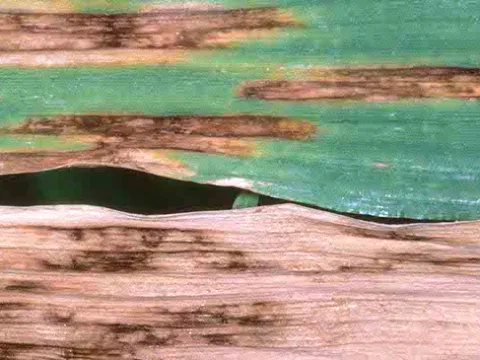
The disease is characterized by distinct brown, net-like lesions on the leaves. These lesions consist of dark brown longitudinal and transverse streaks that form a mesh pattern.
A yellow chlorotic halo often surrounds the necrotic net-like lesions. As the infection progresses, these spots coalesce, causing entire leaves to yellow, dry out, and die prematurely.
In humid weather, a grayish or olive-colored sporulation layer may be visible on the necrotic spots. This layer contains masses of conidia ready to infect healthy parts of the plant.
- Characteristic net-like pattern of dark brown streaks on the leaves.
- Yellowing of leaf tissue surrounding the spots (chlorosis).
- Rapid progression from the bottom leaves to the upper canopy.
- Dark, irregular spots on the ears and stems in advanced stages.
Early symptoms often look like small, dark brown dots. Under bright light or when looking through the leaf, the specific net pattern becomes more visible to the naked eye.
Cultural practices are essential for management: a minimum 2–3 year crop rotation with non-host crops is recommended to reduce inoculum levels in the soil.
Deep plowing and burial of crop residues help accelerate the decomposition of fungal mycelium and pseudothecia, thereby significantly reducing the primary source of infection in the field.
Seed treatment with systemic fungicides is crucial to protect seedlings during the early stages of growth and to prevent the spread of seed-borne pathogens.
Foliar fungicide applications are necessary during the growing season if the disease threshold is met. Targeted applications during the boot stage and heading significantly improve yield protection.
Integrated management, including the use of resistant barley varieties and timely fungicide application, remains the most effective strategy to mitigate the damage caused by net blotch.