
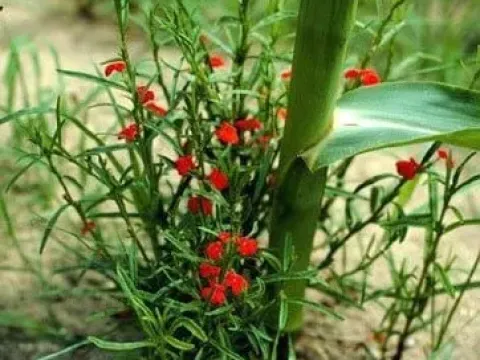
Witchweed
Striga asiatica
Witchweed (Striga asiatica) is a herbaceous annual plant belonging to the Orobanchaceae family. Taxonomically, this species is classified as an obligate root parasite, which cannot complete its lifecycle without obtaining nutrients from the host plant.
What the section contains
Witchweed
Physically, the mature plant reaches 15–30 cm in height and is covered with rough, stiff hairs. Leaves are narrow and lanceolate, arranged oppositely. Flowers are typically bright red or orange, although white or yellow forms exist, which can complicate visual identification in the field.
The root system of witchweed is highly modified: it forms haustoria, specialized organs that penetrate the host plant's roots. Through these structures, the parasite extracts water and essential nutrients, depriving the host crop of resources necessary for growth.
Witchweed seeds are incredibly minute, dust-like particles, with one single plant producing up to 50,000 seeds. They possess remarkable longevity, remaining viable in the soil for 10–20 years while waiting for chemical signals from the roots of a suitable host.
The plant exhibits high ecological plasticity, allowing it to adapt rapidly to diverse environmental conditions, thereby expanding its range across tropical and subtropical agricultural zones worldwide.
The primary victims of Striga asiatica are cereal crops of significant economic importance. Maize, sorghum, millet, sugarcane, and rice are the most susceptible, often suffering from critical yield losses due to infestation.
In regions with severe infestations, entire fields can be destroyed, as the parasite begins to impact the crop even before the witchweed shoots emerge above the soil surface. The host plant loses its ability to till and develop a healthy root system.
The damage is compounded by the fact that the parasite intercepts not only water but also growth hormones, leading to stunting and physical deformation of the host. Infested crops become significantly more susceptible to drought and other environmental stressors.
In addition to cultivated crops, Striga can parasitize certain wild grass species, which serve as reservoirs for the pathogen during fallow periods or when host crops are not present on the field.
The economic impact is considered catastrophic for many developing nations in Africa and Asia, where this weed is a major limiting factor for cereal food production and food security.
Seed germination is triggered strictly by the presence of root exudates (strigolactones) from a host plant. This biological mechanism ensures that the parasite's development is perfectly synchronized with the vegetative cycle of the host.
The active development phase of the aerial parts of the witchweed occurs in mid-summer, coinciding with the flowering and seed maturation periods. The total lifecycle from germination to seed set takes approximately 90–120 days.
The parasite prefers well-warmed soils and moderate humidity levels. However, during periods of extreme heat, it can enter a state of temporary dormancy, resuming development immediately after rainfall events.
Dispersal of seeds occurs via wind, water, agricultural equipment, and contaminated seed lots. Due to their microscopic size, seeds are easily transported over long distances, making quarantine measures difficult.
Following the harvest of host crops, witchweed seeds fall into the soil, forming a persistent soil seed bank that ensures the recurrence of the parasite in subsequent seasons.
The first sign of infestation is atypical stunting of the crop, often mistaken for moisture or nutrient deficiency. Host plants show visible growth retardation, followed by chlorosis (yellowing) and leaf rolling.
At later stages, when the parasite emerges, mass yellowing and wilting of the crop become evident in infested patches. Witchweed shoots with characteristic flowers can be spotted near the base of the cereal plants.
Upon digging up an infested plant, one can observe the haustoria attached to the roots, which appear as dense, knobby outgrowths on the cereal root system.
Yield reduction is usually uneven, manifesting in patches that correlate with the density of seeds in the soil. These patches gradually expand over time, eventually merging into larger, continuous zones of devastation.
Severe infestations lead to a sharp decline in grain quality, resulting in shriveled kernels with significantly lower protein and carbohydrate content, rendering the grain largely non-marketable.
Effective management of Striga requires an integrated approach, as direct herbicide application is often insufficient to eliminate the entire seed bank present in the soil.
- Utilizing "trap crops" that stimulate parasite germination without supporting its development, effectively depleting the seed bank.
- Practicing long-term crop rotation with non-host species, such as cotton or various legumes.
- Hand-weeding or mechanical cultivation before the witchweed reaches the flowering stage to prevent further seed dispersal.
- Deploying crop varieties with genetic resistance or tolerance to Striga infestation.
- Implementing soil fumigation in high-value agricultural systems to sterilize the topsoil layer from viable seeds.