
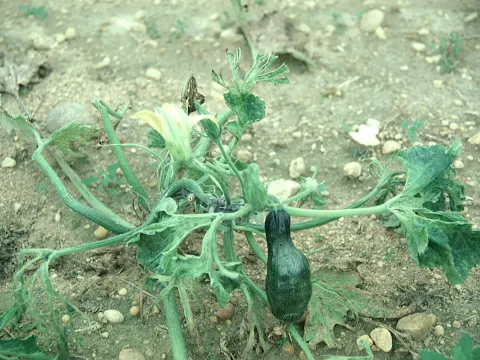
Zucchini yellow mosaic virus
Cucurbit aphid-borne
Zucchini yellow mosaic virus (ZYMV) is a member of the genus Potyvirus, within the Potyviridae family. As an obligate plant parasite, it requires living plant cells for replication and cannot survive long in the environment without a host.
What the section contains
Zucchini yellow mosaic virus
The virus consists of filamentous virions approximately 750 nm in length. It is widely recognized as one of the most economically damaging viruses affecting cucurbits globally, causing severe yield losses in both open fields and greenhouses.
Transmission occurs in a non-persistent manner, primarily via aphid vectors such as Myzus persicae and Aphis gossypii. Because the virus is acquired and transmitted by aphids during very short probing feeds, it spreads extremely rapidly within a field.
Laboratory diagnostics, such as ELISA (Enzyme-Linked Immunosorbent Assay) and RT-PCR, are the gold standard for accurate detection. Visual observation of symptoms is often used for preliminary diagnosis, though it may be confused with other potyviruses.
Its taxonomy defines it as a specialized pathogen, with a host range almost exclusively limited to the Cucurbitaceae family, including squash, pumpkin, cucumber, and melon.
The primary hosts of ZYMV are members of the Cucurbitaceae family. The virus also relies on various perennial weeds as alternative hosts during the off-season, which facilitates its persistence in agricultural landscapes.
In zucchini and pumpkin production, ZYMV is notorious for causing devastating yield losses. Infected plants exhibit severe stunting and produce fruits that are completely unmarketable due to intense malformation.
In intensive farming regions, crop failure due to ZYMV can reach 100% if the infection occurs early in the growing season. The total loss of marketability forces farmers to discard damaged harvests, resulting in massive economic consequences.
Deformed fruits, characterized by bumps, ridges, and severe skin discoloration, fail to meet the standards of retail chains. These aesthetic defects make the produce unsuitable for commercial distribution.
Because the virus is persistent in weed reservoirs, controlling the disease requires a rigorous, long-term approach to farm hygiene and integrated pest management.
The spread of ZYMV is inextricably linked to the seasonal migration and activity cycles of aphid vectors. Outbreaks are most common during the spring and summer when aphid populations are at their peak.
Warm temperatures (20-30°C) are highly conducive to both the rapid development of the virus in the plant and the quick reproduction of aphids. In climate-controlled greenhouses, the disease can persist throughout the year.
The incubation period, from aphid feeding to the appearance of symptoms, usually ranges from 7 to 14 days. The rapid pace of dissemination makes ZYMV one of the most difficult viruses to manage during the peak growing season.
Early-stage plantings are particularly vulnerable. When young seedlings are inoculated by wandering aphids from nearby weeds or infected fields, the damage is often irreversible for the entire crop.
As temperatures drop or aphid activity declines toward the end of the season, the transmission rate slows, but the virus remains viable in crop residues and soil, setting the stage for the following year.
The classic symptoms include a distinct yellow mosaic pattern on the leaves, characterized by alternating patches of light yellow and dark green tissue. Leaves often become severely curled, crinkled, and distorted.
Infected plants exhibit significantly shortened internodes, leading to a stunted or bushy growth habit. Fruit production is severely impacted, with the resulting fruits showing intense deformation, knobby skin, and color mottling.
- Bright yellow mosaic patterns on foliage.
- Leaf distortion and severe crinkling.
- Premature flower and fruit drop.
- Overall stunting and reduced plant vigor.
- Knobby, distorted fruit surfaces and irregular discoloration.
In some resistant or tolerant cultivars, symptoms may be subtle or latent. However, even if the plant shows minimal visual signs, it remains an active reservoir for the virus, posing a threat to neighboring healthy plants.
In early infection stages, look for chlorotic or pale seed leaves (cotyledons), which often serve as the first visible evidence of systemic viral infection.
The primary control strategy is the management of aphid populations. Systematic use of insecticides can reduce the number of vectors, though it is often insufficient on its own due to the speed of non-persistent transmission.
Effective sanitation is critical. Removing host weeds from the field borders and surrounding areas is essential to eliminate the virus's off-season reservoirs.
The most successful method for controlling ZYMV is the use of resistant or tolerant squash hybrids. Modern breeding efforts have yielded varieties that can withstand infection and produce a viable crop despite the presence of the virus.
Implementing spatial isolation between successive plantings of cucurbits helps restrict the movement of aphids from older, infected fields to newer, vulnerable ones.
If an infection is detected, immediate roguing (removal and destruction) of affected plants is recommended to reduce the source of inoculum. All tools used in contact with infected plants must be disinfected to prevent mechanical spread.