
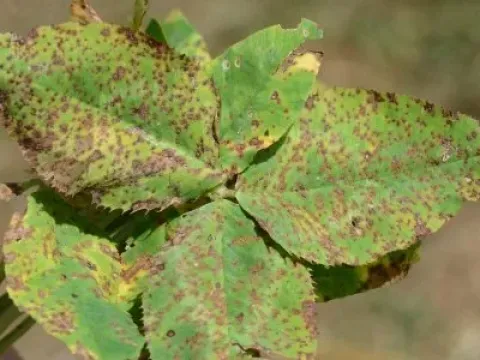
Clover leaf spot
Pseudopeziza trifolii
Pseudopeziza trifolii is a specialized fungal pathogen belonging to the Ascomycota division, causing a common foliar disease known as clover leaf spot.
What the section contains
Clover leaf spot
The fungus develops internally within the leaf tissue, eventually forming small, dark brown or black fruiting bodies called apothecia, typically 0.5–1.5 mm in diameter.
These fruiting bodies produce spores that are disseminated by wind and water splashes to healthy clover plants during the growing season.
The life cycle of this pathogen includes both sexual and asexual stages, allowing it to adapt and persist in various environmental conditions.
The fungus overwinters on crop residues, dead leaves, and sometimes in the crown of the clover plant, serving as a primary source of infection for the next season.
Clover leaf spot primarily affects various species of the genus Trifolium, including red clover and white clover, in major production regions worldwide.
The pathogen attacks leaves, petioles, and occasionally stems, which disrupts photosynthesis and significantly reduces the plant's overall vitality.
The main economic impact is the premature senescence and dropping of leaves, which leads to substantial losses in total forage biomass and nutritional quality.
Severely infected fields exhibit reduced growth rates, lower seed yields, and decreased stand longevity, requiring earlier field rotation or reseeding.
In cases of high disease pressure, the reduction in feed value can be critical for livestock operations that rely on high-quality clover hay.
Symptoms typically appear during mid-summer, especially after the first harvest, when weather conditions become warm and humid.
Favorable conditions for the spread of the pathogen include temperatures ranging from 18°C to 22°C and frequent precipitation or heavy dew.
The pathogen can undergo multiple infection cycles during a single growing season if environmental conditions remain conducive to fungal growth.
Dense clover stands are particularly susceptible, as they trap moisture and create an ideal microclimate for the germination of fungal spores.
As autumn approaches and temperatures drop, the rate of new infections slows down, and the fungus transitions into a dormant stage for the winter period.
The initial signs include the development of small, circular, dark brown to black spots scattered across the leaf surfaces.
These spots are well-defined but usually do not possess a chlorotic halo, which is a key characteristic to distinguish it from other leaf spot pathogens.
As the infection progresses, a small black disk (the apothecium) appears in the center of the spot, which is the hallmark diagnostic feature of Pseudopeziza trifolii.
Heavily infected leaves may turn yellow, curl up, and prematurely shed from the plant, leading to sparse foliage on the lower parts of the stem.
- Dark brown, circular spots with a central black disk.
- Premature yellowing and leaf drop.
- Reduced stand density and overall biomass quality.
Cultural management is the primary defense, including crop rotation practices where clover is not returned to the same soil for several years.
Timely harvesting of the clover stand helps prevent the accumulation of moisture and reduces the inoculum load for the next regrowth cycle.
Deep plowing or incorporating crop residues into the soil helps degrade the fungal structures, limiting the survival of the pathogen over the winter.
Planting resistant clover varieties remains the most effective long-term strategy for minimizing the impact of leaf spot disease in large-scale fields.
In seed production areas, chemical control with appropriate fungicides may be used if the disease pressure exceeds established economic thresholds.