
Clover black blotch
Cymadothea trifolii
Clover black blotch, caused by the fungus Cymadothea trifolii, is a common and specialized pathogen affecting clover species (Trifolium spp.). It belongs to the Dothideomycetes class and is recognized for its unique life cycle.
What the section contains
Clover black blotch
The asexual (conidial) stage of this fungus is widely known as Polythrincium trifolii. This stage is responsible for the rapid spread of spores across clover fields during the growing season when environmental conditions are favorable.
The fungus is an obligate parasite, meaning it requires living clover tissue to survive and reproduce during the summer. Its mycelium grows within the leaf tissues, eventually breaking through the surface to release spores.
Winter survival is achieved through pseudothecia, which are small fruiting bodies that develop on fallen infected leaves. These structures remain in the soil debris, serving as the source of primary inoculum when spring arrives.
Taxonomically, the fungus is highly adapted to its host, making it a persistent resident in regions where clover is cultivated for forage or seed production.
The primary impact of Cymadothea trifolii is the reduction of the plant's photosynthetic surface area. By infecting the leaves, the pathogen causes chlorosis, necrosis, and premature leaf drop.
Forage quality is significantly compromised as infected leaves become brittle and less palatable to livestock. Farmers often experience a decrease in crude protein and total digestible nutrients in the harvest.
Severe infections can reduce total biomass production by a notable percentage, especially during the second and third cuts of the season, when humidity levels often favor the fungus.
Persistent infection weakens the entire plant, affecting its root storage capacity. This susceptibility often leads to reduced overwintering success, causing thinning of the stand in subsequent years.
The cumulative effect is a decrease in the longevity of the clover stand, which forces producers to replace the crop sooner than anticipated, increasing farm operation costs.
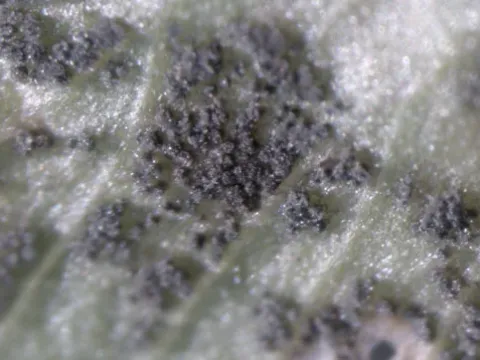
The disease first appears as small, scattered black spots on the underside of the leaves. These spots are composed of dense clusters of conidiophores, which give them a dark, velvety appearance.
As the infection matures, these spots can enlarge and eventually merge. They may also appear on the upper side of the leaf, though they are usually more abundant on the lower surface.
In humid conditions, the black spots become very prominent, and a fine powder of spores can be seen spreading from these areas. This spore release is critical for the secondary spread of the disease.
Affected leaves often turn yellow at the edges and eventually wither entirely. This results in a distinct, patchy appearance across the field where foliage seems to be drying up prematurely.
At the end of the season, tiny black dots—pseudothecia—become visible on decaying leaf residues. These serve as indicators that the fungus is preparing to overwinter in the field soil.
Crop rotation is the most effective cultural practice to manage Clover black blotch. By avoiding clover in the same field for several years, growers can effectively reduce the population of the pathogen.
Deep plowing of field residues after harvest is crucial to bury the infected leaves. This process accelerates decomposition and prevents the spores from reaching new sprouts in the following season.
Selecting resistant cultivars remains the best long-term strategy for minimizing damage. Breeding programs often focus on plant vigor and leaf health to naturally suppress fungal growth.
Timely harvesting of the crop is recommended. By cutting the clover before severe leaf loss occurs, farmers can remove a significant portion of the pathogen's spores before they spread further.
While chemical control is possible, it is usually reserved for high-value seed crops. Fungicide application should be performed based on threshold monitoring to ensure economic viability and safety.