
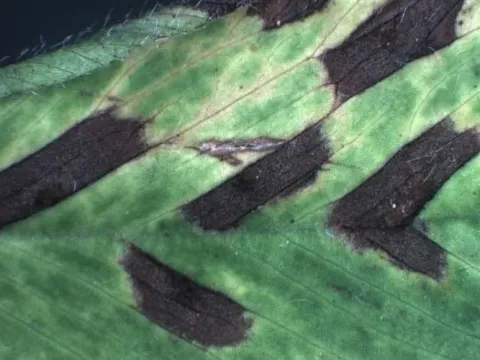
Clover cercospora leaf spot
Cercospora zebrina
The causal agent of clover leaf spot is the imperfect fungus Cercospora zebrina, which belongs to the kingdom Fungi and the division Ascomycota. It is a highly specialized plant pathogen affecting various clover species.
What the section contains
Clover cercospora leaf spot
The fungus develops mycelia within the leaf tissues, eventually breaking through the epidermis to produce conidiophores and conidia. These spores are the primary means of survival and dissemination in the environment.
The pathogen thrives in temperate climates, surviving the winter as dormant mycelium or as spores on infected plant debris and soil. Its resilience allows it to persist in fields for multiple seasons.
Transmission occurs through wind and rain splash, which effectively move the conidia from the soil surface onto the susceptible lower leaves of clover plants during the growing season.
Proper identification relies on observing the distinct necrotic lesions on leaves and verifying the presence of fungal sporulation under a microscope in laboratory settings.
The primary impact of Cercospora zebrina is the reduction of forage quality and total biomass yield in clover crops. Infection can severely impair the nutritional value of hay by lowering protein levels.
The disease attacks leaves, petioles, and stems, causing tissue necrosis and premature defoliation. By disrupting photosynthesis, the fungus weakens the plant's overall vitality and root development.
In seed production fields, the pathogen causes shriveled, low-viability seeds, significantly reducing the economic output of the crop. Severe outbreaks can lead to complete loss of the second or third cut.
Infected stands are more susceptible to winter-kill and environmental stress, leading to thinner plant populations in subsequent years. This often forces farmers to renovate pastures sooner than expected.
The overall damage contributes to decreased livestock productivity, as the affected forage provides less energy and nutrients compared to healthy, disease-free crops.
The disease typically emerges in the late spring and reaches its peak during the warm, humid conditions of summer. Rainfall events significantly accelerate the spread of the pathogen.
High relative humidity and moderate temperatures (around 20–25°C) create an optimal environment for the rapid germination of conidia and the infection of new leaf tissues.
The period following the first harvest is particularly critical, as the regrowth of clover is often highly vulnerable to infection from spores that have persisted on the soil surface.
As autumn approaches and temperatures decline, the disease activity gradually slows down. However, the fungus remains active in plant debris, preparing for the next year's cycle.
Monitoring should be most intense during wet summer months, as these conditions are strongly correlated with the rapid onset and expansion of cercospora leaf spot outbreaks.
Symptoms are characterized by small, scattered, dark spots on the leaf blades. These spots typically feature a light, grayish center with a dark brown or reddish border.
As the infection progresses, lesions expand and merge, causing large portions of the leaf to wither. In humid conditions, a fine, grayish mold may be visible on the lesion surfaces.
Defoliation often occurs, starting from the lower parts of the plant and moving upwards. Infected stems may show elongated, brown lesions, leading to lodging or stem breakage.
- Characteristic leaf spots with a pale center.
- Yellowing and premature death of leaves.
- Visible fungal sporulation (mold) on the underside of leaves.
- Stunting of overall plant development.
- Brown, elongated lesions on stems and petioles.
The appearance of "blotchy" or spotted leaves is a reliable visual cue, helping farmers distinguish this disease from other leaf-spotting fungi affecting legumes.
A successful management strategy integrates crop rotation and field sanitation. Rotating clover with non-leguminous crops every 4-5 years is essential to break the pathogen's life cycle.
Deep plowing of crop residues is an effective cultural practice to bury infected plant material, facilitating its rapid decomposition and preventing the release of spores.
Using certified, clean, and disease-free seeds is the first line of defense. Additionally, planting resistant cultivars significantly reduces the likelihood of a severe outbreak.
Maintaining balanced soil fertility, especially adequate phosphorus and potassium levels, helps plants build the necessary resistance to defend against initial infections.
In high-value seed production areas, the application of registered fungicides may be necessary during periods of high humidity to suppress the spread of the fungus.