
Pileolaria terebinthi
Pileolaria terebinthi
Pileolaria terebinthi is an obligate pathogenic fungus belonging to the class Basidiomycetes and the order Pucciniales. This microorganism is a specialized parasite that primarily affects plants within the Anacardiaceae family.
What the section contains
Pileolaria terebinthi
Systematically, this species belongs to the family Pileolariaceae. Its life cycle involves various spore stages typical of many rust fungi, making it highly adaptive to environmental conditions.
The primary modes of pathogen dispersal are urediniospores and teliospores, which are carried by wind or raindrops over significant distances. The mycelium develops within the host tissues, extracting nutrients via specialized structures called haustoria.
Microscopic examination of the spores allows for precise identification: the teliospores of Pileolaria terebinthi have a distinct shape and coloration, serving as a key diagnostic feature in laboratory analysis of infected pistachio samples.
The pathogen survives as dormant spores on fallen leaves and plant debris, ensuring its survival throughout the winter and facilitating the start of a new infection cycle in the spring.
The primary hosts for this fungus are trees of the genus Pistacia, including the commercial pistachio tree, which holds significant agricultural importance.
The pathogen primarily attacks the foliage, though it occasionally infects petioles and young shoots, leading to premature leaf drop and the overall weakening of the tree.
In regions with developed pistachio cultivation, infection by this fungus leads to a significant decrease in canopy photosynthetic activity, which directly affects the yield and quality of the nut harvest.
Severe infection over several seasons can lead to canopy defoliation, negatively impacting the tree's winter hardiness and its ability to develop floral buds for the following year.
The economic impact involves not only the loss of crop volume but also the high costs associated with implementing protective measures and the decline in the long-term vitality of industrial plantations.
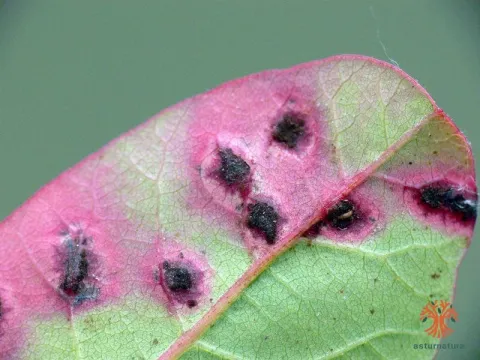
Initial symptoms of the disease appear as small chlorotic spots on the upper side of the leaf blade, which eventually become more pronounced and undergo necrosis.
On the underside of the leaf, characteristic pustules (fruiting bodies of the fungus) form, appearing rusty-brown or dark-brown in color and containing masses of pathogen spores.
As the infection progresses, affected leaf areas may coalesce, forming large necrotic zones, which result in premature drying and curling of the leaf tissue.
Under conditions of high humidity, a powdery coating consisting of a vast number of mature spores, ready for further dissemination, may be observed on the leaf surface.
- Yellowing of specific leaf zones.
- Formation of dark, powdery pustules on the leaf underside.
- Premature shedding of infected foliage.
- Reduction in nut quality and overall weight.
The primary control method involves cultural practices, specifically the thorough removal and destruction (burning) of fallen leaves, where the majority of the fungal inoculum overwinters.
Regular sanitary pruning of the canopy is recommended to improve air circulation; this reduces humidity within the tree structure and hinders spore germination.
In commercial orchards, the application of copper-based fungicides or systemic triazole-class treatments during periods of peak fungal activity is an effective strategy for management.
An essential element of integrated pest management is the selection of resistant pistachio cultivars, which are bred to withstand local populations of this dangerous rust fungus.
Monitoring the health of pistachio plantations should occur throughout the growing season, beginning at the bud-burst stage, to ensure timely implementation of protective measures.