
Pink root of onion
Setophoma terrestris
Description
How to identify
The causal agent of pink root is the fungus Setophoma terrestris (formerly Pyrenochaeta terrestris). It belongs to the Coelomycetes group and is a widespread soil-borne pathogen affecting various Allium species.
The pathogen survives in the soil as sclerotia or mycelium on infected plant debris. It can persist in the environment for several years, making it a difficult pathogen to eradicate in continuous cropping systems.
Dissemination occurs through infested soil, contaminated irrigation water, and the movement of agricultural equipment. The fungus thrives in warm conditions and targets the root cortex.
Laboratory identification involves isolating the fungus on culture media, where it produces characteristic pycnidia. This microscopic examination is essential to distinguish it from other root pathogens like Fusarium.
Understanding that it is a facultative parasite allows growers to realize that crop rotation alone may not completely eliminate the fungus, as it can survive as a saprophyte.
What it damages
Onions are the primary host for Setophoma terrestris, but the disease also affects garlic, leeks, shallots, and even some grasses. The damage occurs primarily at the root level.
Infected roots lose their ability to absorb water and nutrients. As a result, the plant experiences reduced vigor, yellowing of leaves (starting from the tips), and eventual wilting during hot periods.
The yield losses can be substantial, as bulbs fail to size properly. This leads to reduced marketability and smaller harvest weights. Infected bulbs are also more susceptible to storage rots.
Under severe pressure, the entire root system may turn pink and eventually disintegrate. This results in the plant being easily dislodged from the soil when pulled.
The economic impact is high because the disease is difficult to notice until the damage to the root system is already extensive and the plant begins to show stress symptoms above ground.
When it appears
Pink root is a warm-weather disease. The fungus is most active when soil temperatures reach 24–28 °C. It is particularly damaging in hot, arid climates or during high-temperature growing seasons.
Infection can occur at any stage, from seedling to maturity. However, the symptoms become most apparent as temperatures rise during the middle of the growing season.
Cooler soil temperatures inhibit fungal activity, but the pathogen remains dormant until conditions improve. This cycle makes it a persistent threat in many onion-growing regions.
Irrigation practices play a role, as high soil moisture combined with warm temperatures accelerates the spread of spores throughout the root zone.
The disease cycle can repeat several times throughout the season, leading to a build-up of inoculum that persists in the field for subsequent years.
Signs of infestation
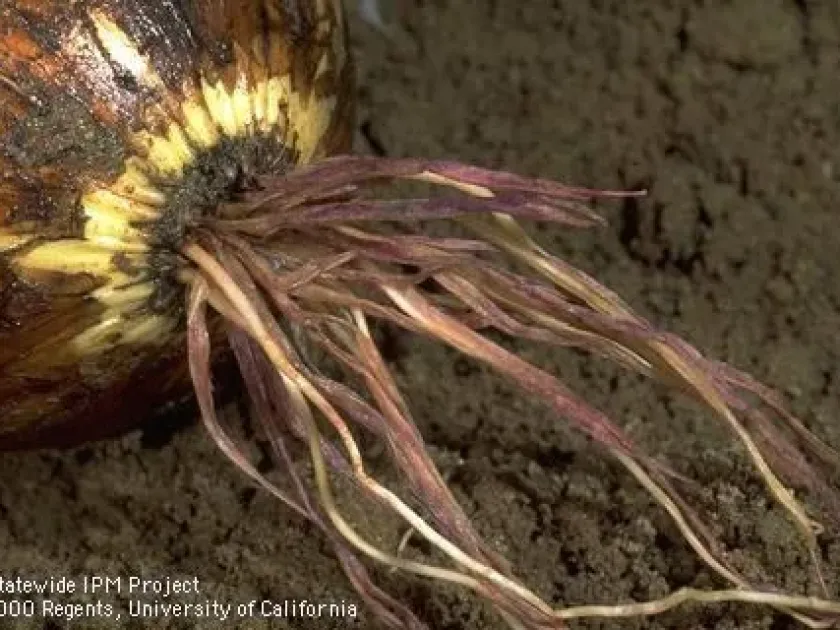
The most diagnostic symptom is the color change of the roots. Initially, they turn light pink, then darken to a deep red or purple, and finally wither and decay.
- Stunted plant growth and reduced vigor.
- Yellowing and tip burn of older leaves.
- Roots showing pink to reddish-brown coloration.
- Total loss of functional root mass.
- Easy uprooting of the plant due to lack of a healthy anchor system.
Above-ground symptoms can often mimic drought stress or nutrient deficiencies, which can delay accurate diagnosis if the root system is not checked.
In advanced stages, the decaying roots may turn gray or brown as secondary fungi invade the compromised tissue, potentially masking the characteristic pink color.
When pulling an affected onion, the root system will appear short, discolored, and fragile, clearly indicating the lack of active root health.
Control measures
The primary control strategy is a long-term crop rotation, ideally avoiding Allium species for at least 4 to 5 years. This practice reduces the fungal population in the soil.
Selecting resistant cultivars is the most effective approach for managing pink root. Breeders have developed many onion hybrids that show significant resistance to this pathogen.
Good soil management, including adequate drainage and avoiding soil compaction, helps maintain plant vigor, allowing the crop to better withstand infection.
Chemical control using soil fungicides or seed treatments can provide protection in heavily infested areas, though these methods are generally used as a preventative measure.
Post-harvest sanitation, including the removal and destruction of crop residues, is crucial to prevent the further buildup of Setophoma terrestris in the soil.
Causes diseases · 2
Discussion
No discussions yet — be the first.