
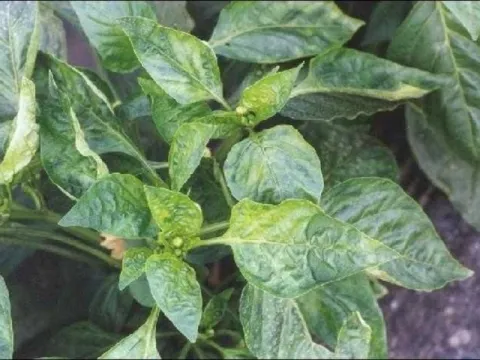
Pepper mild mottle virus
Pepper mild
The causative agent of the disease is the Pepper mild mottle virus (PMMoV), which belongs to the genus Tobamovirus. It is an extremely stable RNA-containing virus that affects a wide range of Solanaceae crops, including sweet and hot peppers.
What the section contains
Pepper mild mottle virus
Systematically, the virus is classified within the family Virgaviridae. It is characterized by high survival rates in the external environment, retaining infectious capacity in plant debris, soil, and even on the surface of seeds for long periods.
The virus is easily transmitted mechanically through handling, contact between infected and healthy tissues, and through contaminated tools or personnel hands. It is not transmitted by insect vectors, making contact transmission the primary route of spread.
The intracellular development of the pathogen leads to metabolic disruption of the host plant, suppression of photosynthesis, and tissue deformation. The incubation period depends heavily on temperature and the overall health of the plant.
The infection is often localized but spreads rapidly throughout greenhouses or fields if hygiene protocols are violated. High concentrations of viral particles in plant sap facilitate quick infection of adjacent plants during pruning or harvest.
The main crops at risk are peppers (Capsicum annuum) and some tomato varieties. The virus causes significant economic losses by reducing both the market value of the produce and the overall yield of the plantations.
Early-stage infection of young plants leads to severe stunting, growth retardation, and loss of vitality. Mature plants suffer less damage, but their fruits lose marketability, making them unsuitable for commercial sale.
In plantations where crop rotation and disinfection standards are not followed, yield losses can reach 30–50% or more. The virus affects both greenhouse and open-field crops, with greenhouse conditions favoring faster spread.
Fruits from infected plants often display uneven coloring, becoming small and distorted. Internal tissues may appear dry or necrotic, significantly reducing shelf life and post-harvest quality during transport.
Beyond direct yield loss, the virus depletes soil health and increases the risk of infection for subsequent crops if thorough soil cleaning and disinfection measures are not implemented after plant removal.
Typical signs of infection include characteristic mottling of leaves, pale green or yellow patches, and pronounced curling of leaf blades. Leaves become small, narrow, and sometimes thread-like in appearance.
Symptoms include:
- Chlorotic spots on young leaves.
- Severe deformation and curling of leaf margins.
- Stunted internodes, giving the plant a bushy or compact appearance.
- Development of necrotic spots on stems and fruits.
- Flower and fruit drop, leading to significant yield reduction.
Visual diagnosis is often challenging as symptoms may mimic nutrient deficiencies or mite damage. For accurate identification, methods such as ELISA or PCR are used to detect the presence of viral RNA.
On fruits, symptoms may manifest as mottling or angular spots that eventually turn brown. Internal fruit septa may darken, which is a critical indicator for professional agronomists.
In chronic forms, the plant does not die but remains a reservoir for the virus, continuing to contaminate the surrounding environment and equipment throughout the entire growing season.
The primary management strategy is based on prevention and strict adherence to sanitary and hygiene standards. Since there are no effective curative chemical treatments for the virus, all efforts must focus on preventing pathogen entry.
Use only certified, virus-tested seed material. When necessary, perform thermal treatment or seed disinfection with specialized solutions to reduce viral load on the seed coat.
Regular disinfection of tools, containers, and personnel hands during plant handling is mandatory. PMMoV is highly resistant to standard conditions, so tools must be treated with strong disinfectants or subjected to heat sterilization.
Upon detecting the first signs of disease, infected plants must be immediately removed along with the root ball and destroyed far from the site. Following removal, localized soil disinfection and monitoring of surrounding healthy plants are required.
Adherence to crop rotation and avoiding Solanaceae cultivation on the same plot for at least 3-4 years significantly reduces infection risk. In greenhouses, complete soil replacement or steaming is recommended after each production cycle.