
Rice sheath blight
Pellicularia sasakii
The causal agent of rice sheath blight is the fungus Pellicularia sasakii (synonym: Rhizoctonia solani), a member of the Basidiomycota phylum. This pathogen is notorious for its ability to persist in the soil and on crop debris for extended periods.
What the section contains
Rice sheath blight
It does not produce asexual spores but instead spreads via mycelium and sclerotia. Sclerotia are hard, dark-colored structures that allow the fungus to survive harsh environmental conditions in the absence of a host.
The mycelium grows rapidly in moist environments, initially appearing white and later turning light to dark brown. Its growth rate is highly sensitive to humidity and temperature levels within the crop canopy.
Pellicularia sasakii acts as both a saprophyte and a necrotrophic parasite. It colonizes the host tissue by releasing enzymes that break down cell walls, leading to the characteristic blight symptoms.
Understanding the life cycle of this pathogen is essential for effective disease management, as it is a soil-borne fungus that thrives in the specialized conditions of flooded paddy fields.
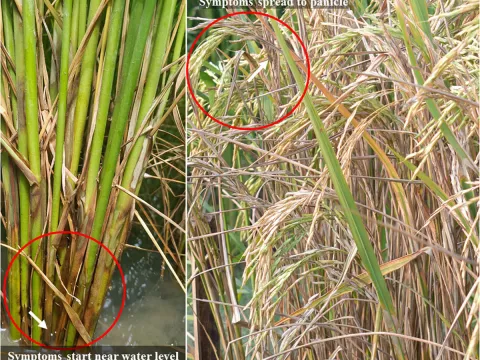
Rice is the primary host for Pellicularia sasakii. The fungus specifically attacks the leaf sheaths and blades near the water line, disrupting the plant's vascular system.
Beyond rice, this fungus is a generalist pathogen that can infect several other crops, including soybeans, corn, and various turfgrasses, which complicates agricultural management.
The infection causes necrotic lesions that hinder the upward transport of water and nutrients, resulting in the stunting of plants and the death of lower leaves and tillers.
Severely infected plants often suffer from lodging, which significantly complicates harvesting processes and reduces the overall grain quality and yield potential.
In cases of severe outbreaks, yield losses can range from 30% to over 50%. This loss is primarily driven by the production of empty, light, or shriveled grains in the panicles.
The disease development is heavily dependent on weather conditions. High humidity (above 90%) and warm temperatures (25–30°C) are optimal for the growth and spread of the fungus.
Outbreaks usually occur during the tillering and jointing stages of rice. At these stages, the dense canopy reduces airflow and creates a warm, humid microclimate that favors the fungus.
Heavy rainfall and irrigation water facilitate the movement of sclerotia throughout the paddy field, spreading the infection from initial foci to the rest of the crop.
During the night, especially with high dew or fog, the mycelium emerges from the lesions and bridges the gap to neighboring healthy plants, accelerating the spread.
Extended periods of high moisture, combined with warm nights, are the primary triggers for rapid disease progression during the mid-to-late vegetative stages.
The initial symptoms are oval-shaped lesions on the leaf sheaths. These lesions start as water-soaked spots that eventually turn grayish-green or light brown.
As the lesion matures, the center becomes bleached or straw-colored, surrounded by a distinct dark brown border, which is a classic diagnostic feature of this disease.
When humidity is high, a white, web-like mycelial mat becomes visible over the lesions, eventually developing into small, dark brown, seed-like sclerotia.
- Yellowing and drying of lower leaves.
- Soft, rotting tissue at the base of the stem.
- Premature death of tillers.
- Incomplete grain filling in the panicles.
In advanced stages of infection, patches of rice plants appear withered or scorched, making it easy to identify the infected areas from a distance in the field.
Integrated disease management (IDM) is required. Key practices include deep plowing after harvest to bury sclerotia and reduce the primary inoculum load in the field.
Optimizing plant spacing is crucial to improve air circulation and reduce canopy humidity. Consistent weeding is also necessary to remove alternative hosts for the fungus.
Chemical control involves the use of systemic fungicides. Applications are most effective when timed with the early appearance of symptoms or during high-risk environmental conditions.
The use of resistant or tolerant rice varieties is the most sustainable approach to reduce the impact of the disease and minimize the need for frequent chemical spraying.
Monitoring the water level in paddy fields and avoiding excessive nitrogen fertilization can also help suppress the development of the pathogen by limiting succulent tissue growth.