
Southern blight
Pellicularia rolfsii
Description
How to identify
Pellicularia rolfsii is a devastating soil-borne plant pathogenic fungus. Its most commonly encountered stage is the anamorphic state, Sclerotium rolfsii, which is responsible for the destructive symptoms observed in the field.
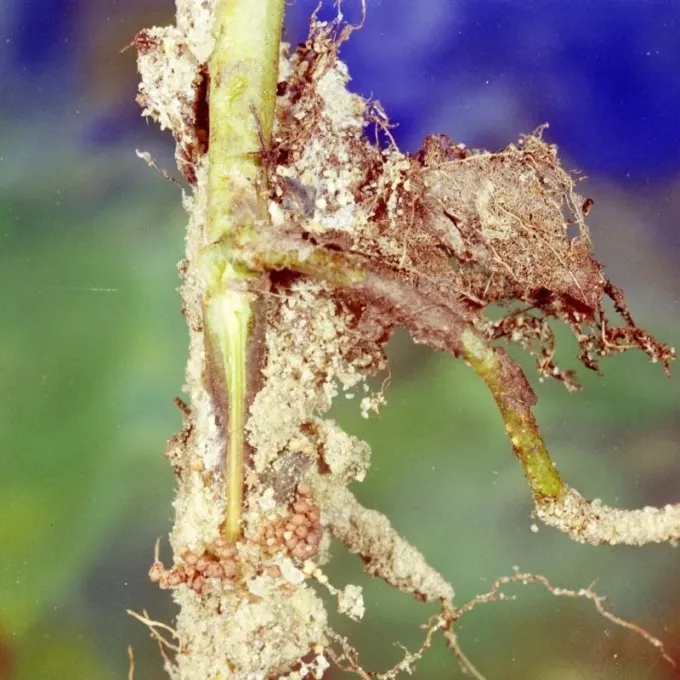
The fungus is characterized by the production of numerous sclerotia, which are small, round, and mustard-seed-like structures. These sclerotia are pigmented brown and serve as the primary survival mechanism for the pathogen in adverse conditions.
The vegetative state of the fungus consists of rapidly growing white mycelium that forms distinct fan-shaped mats. This mycelial growth is highly aggressive and allows the pathogen to spread quickly across the soil surface and plant stems.
Taxonomically, the fungus is classified within the division Basidiomycota. It is a facultative parasite, meaning it can survive as a saprophyte on decaying plant debris in the soil when a living host is unavailable.
In a laboratory setting, the identification is based on the morphological observation of the sclerotia and the characteristic rapid mycelial growth on potato dextrose agar, which eventually covers the entire petri dish.
##damage##Southern blight has a massive host range, attacking over 500 species of plants, including essential economic crops such as tomatoes, peppers, peanuts, beans, and various ornamental species.
The pathogen primarily infects the crown, lower stem, and root systems of plants. Once the tissue is colonized, the fungus disrupts the transport of water and nutrients, causing rapid wilting and eventual plant death.
Fruit decay occurs when the pathogen moves from the soil to the fruit surface. This results in soft, watery rot, which renders the produce completely unmarketable and destroys harvest yields within days.
Severe infestations can lead to total crop failure, particularly in regions with high temperatures and adequate moisture. In agricultural systems, this leads to significant economic loss due to reduced plant density.
The pathogen also damages the root systems of seedlings, resulting in pre-emergence or post-emergence damping-off, which often requires total replanting of the affected field areas.
When it appears
The development of the disease is strictly dependent on temperature and moisture. Optimal conditions occur during warm weather, with temperatures ranging between 25°C and 35°C, combined with high humidity.
The infection process starts when sclerotia germinate in the upper soil layers. This process is triggered by the presence of organic matter and high soil moisture levels, typically after rain or irrigation.
The spread of the fungus within a field is facilitated by the movement of water, contaminated farm machinery, and the movement of infected plant materials, such as seedlings or debris.
In temperate climates, the disease is most prevalent in mid-to-late summer. In tropical or subtropical climates, the pathogen remains active throughout the entire growing season of most crops.
High plant density and restricted airflow within the crop canopy create a microclimate that is extremely favorable for the fungal colonization and spread from one plant to another.
Signs of infestation
The first clinical sign of infection is the yellowing and wilting of the lower leaves. As the infection progresses, the entire plant rapidly collapses due to the decay of the stem near the soil line.
A dense, white, thread-like mycelium is visible around the base of the stem and on the soil immediately surrounding the plant. This white mat is a hallmark of the pathogen's presence.
Within the white mycelium, brown, spherical sclerotia begin to develop, which become increasingly obvious as the infection matures and the mycelium begins to fade.
Root system damage is extensive; when infected plants are pulled from the soil, the roots appear dark, decayed, and easily fragmented, leaving much of the root system in the soil.
For fruit-bearing plants, the sign of infection is a watery, soft rot spot that expands rapidly until the entire fruit becomes a mass of decayed tissue, often covered with the characteristic white fungal threads.
Control measures
Integrated pest management is essential for controlling southern blight. A primary strategy includes crop rotation using non-host species, such as corn or other cereals, to reduce the sclerotia population in the soil.
Deep plowing or burying plant residues helps move sclerotia into deeper soil layers, where environmental conditions are less favorable for their germination and infection of crop roots.
Chemical control involves the application of fungicides, particularly those containing azoles or other broad-spectrum systemic compounds, to the soil or as a seed treatment to provide initial protection.
Proper irrigation management is vital; drip irrigation is preferred over overhead spraying to keep the stem and root collar area as dry as possible, which significantly inhibits fungal development.
Biological control agents, such as formulations containing Trichoderma species, are effective in suppressing the pathogen by competing for space and resources, thereby reducing the incidence of infection.
Causes diseases · 2
Discussion
No discussions yet — be the first.