
Absidia
Absidia
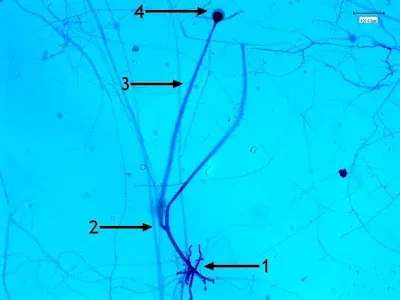
Description
How to identify
The genus Absidia belongs to the kingdom Fungi, phylum Mucoromycota, and family Lichtheimiaceae. These are microscopic fungi that primarily act as saprotrophs but can exhibit significant phytopathogenic properties under specific conditions.
The fungus is characterized by rapid mycelial growth, forming dense, fluffy colonies, often with a grayish or whitish tint. A key structural feature is the presence of branched sporangiophores bearing pear-shaped sporangia.
Unlike other members of the Mucorales order, Absidia sporangia possess a distinct collar (apophysis) at their base, which serves as a crucial taxonomic identifier during microscopic analysis.
Reproduction occurs asexually via endogenous spores (sporangiospores), which are easily dispersed by air currents, water, or insects, ensuring rapid colonization of the substrate.
Biologically, this fungus acts as a facultative parasite capable of surviving for long periods in soil or on plant debris, transitioning to active tissue infection when plant immunity is compromised.
What it damages
Absidia primarily affects vegetable, fruit, and berry crops during post-harvest storage and transportation. Common hosts include tomatoes, strawberries, grapes, and various root vegetables.
In field conditions, the fungus attacks weakened plants, specifically those with mechanical injuries, cracks, or pest-induced wounds that provide easy entry points for fungal hyphae.
The infection of produce in contact with damp soil poses a significant risk. The fungus rapidly colonizes fleshy tissues, turning them into a soft, watery mass often accompanied by a pungent odor.
Beyond fresh produce, Absidia can affect seed material, reducing germination rates and causing infection in seedlings during the early post-sowing stage, leading to poor crop stands.
In greenhouse environments, the fungus can infect seedlings, particularly under conditions of over-irrigation and poor ventilation, causing "damping-off" due to the destruction of the root zone.
When it appears
Active development occurs during periods of high humidity and moderately warm temperatures (optimum 20–28°C), frequently coinciding with the harvesting and ripening season.
In storage facilities, infection intensifies when ventilation protocols are ignored and humidity is poorly regulated, leading to condensation on the surface of stored goods.
The most severe outbreaks are observed following rainy weather during the harvest period, when produce absorbs excess moisture, making it highly susceptible to pathogen infiltration.
The incubation period, from the moment spores land on the plant tissue until visible signs of infection appear, can be as short as 24–48 hours under favorable conditions.
Spore dissemination continues throughout the entire growing season, though infection peaks occur during fruit formation and ripening stages, when tissue sugar content is at its highest.
Signs of infestation
The first sign of infection is the appearance of a fluffy white mycelial mat on the surface of fruit or stems, which eventually develops a grayish tint.
Affected tissues become soft, water-soaked, and lose structural integrity, rapidly turning into an amorphous, decaying mass.
When root vegetables or bulbs are affected, the fungal growth can penetrate deeply into the tissue, causing darkening and necrosis, rendering the product completely unmarketable.
- Development of a white, cotton-like mycelial layer.
- Rapid softening of the infected area.
- Distinctive acidic or fermentation odor.
- Blackening of tissues in advanced stages.
- Lack of clear boundaries between healthy and diseased tissue.
Microscopic inspection reliably reveals the presence of characteristic sporangiophores, allowing for the precise distinction of Absidia from other mold species.
Control measures
The fundamental strategy for control involves strict adherence to good agricultural practices: preventing waterlogged soil and ensuring proper drainage in field plots.
Timely harvest is critical, as is the prevention of mechanical damage to produce, since any physical injury serves as a gateway for the pathogen.
In storage environments, it is essential to strictly monitor temperature and humidity levels, provide regular aeration, and maintain rigorous sanitation of storage containers.
To prevent the spread of infection in crops, scheduled fungicidal treatments targeting fungal microflora should be applied in accordance with regional regulations for specific crops.
The destruction of crop residues and adherence to sound crop rotation practices significantly reduce the soil's infection load, limiting the primary source of the pathogen.
Causes diseases · 1
Discussion
No discussions yet — be the first.