
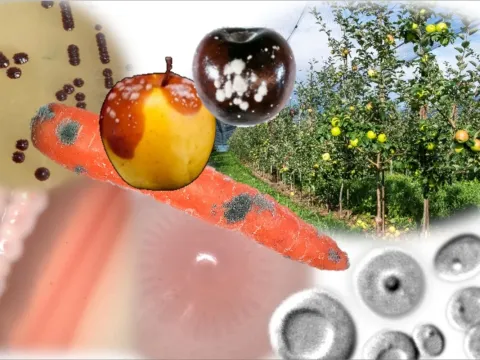
Metschnikowia pulcherrima
Metschnikowia pulcherrima
Metschnikowia pulcherrima is a species of yeast belonging to the phylum Ascomycota and the class Saccharomycetes. In agricultural contexts, it is recognized as an opportunistic pathogen that colonizes fruits and berries, often thriving on sugar-rich surfaces.
What the section contains
Metschnikowia pulcherrima
Microbiologically, this yeast is characterized by its ability to produce a distinct red pigment known as pulcherrimin when grown on specific laboratory media. This trait is a key identifier for researchers studying the dynamics of yeast populations in orchard environments.
The life cycle of this organism involves both budding (vegetative propagation) and the production of ascospores, which allow it to survive periods of nutritional stress or extreme environmental conditions on plant debris and soil surfaces.
While often categorized as an epiphyte, Metschnikowia pulcherrima can switch to a pathogenic mode when it encounters damaged fruit tissue. It is commonly found in the mycobiome of various crops, including vineyards and stone fruit orchards.
Research into this species is dual-natured; while some strains are studied as biological control agents against other fungal diseases, the species as a whole is responsible for significant economic losses due to fruit rot during ripening and storage.
The primary damage caused by Metschnikowia pulcherrima occurs in fruit crops such as grapes, apples, pears, peaches, and strawberries. It targets maturing fruits when sugar levels are at their highest, making them highly susceptible to yeast proliferation.
Infection results in tissue softening and decay, rendering the fruit commercially unviable. The degradation of internal tissues leads to a loss of structural integrity and quality, often making the produce unsuitable for fresh market sale or industrial processing.
In viticulture, this pathogen is associated with sour rot. It significantly impacts wine quality by altering the chemical composition of the must, introducing off-flavors, and negatively affecting the acidity balance, which reduces the final value of the vintage.
Post-harvest, the pathogen spreads rapidly in confined storage spaces through contact. If infected fruits are not removed, the yeast can contaminate healthy produce, leading to substantial losses in warehouses where ventilation and humidity control are inadequate.
Beyond direct spoilage, the presence of this yeast creates a conducive environment for secondary infections by other molds and bacteria, which can accelerate the total destruction of the fruit tissues and serve as a reservoir for further spread.
The pathogen is most active during the late summer and early autumn when high humidity and moderate temperatures provide ideal conditions for growth. Morning dews and frequent rains facilitate the dispersion of spores across fruit surfaces.
Infections peak as harvest approaches. Temperature fluctuations between day and night often lead to skin micro-cracks in fruit, providing entry points for the yeast, which then exploits the high sugar content of the fruit pulp.
Within storage facilities, the seasonality is replaced by controlled environmental conditions. High humidity levels in storage chambers remain the critical factor, acting as a catalyst for yeast outbreaks if cooling systems fail.
In the field, the incubation period can be as short as a few days under optimal conditions (20–25 degrees Celsius). This rapid pace of reproduction necessitates careful monitoring by agronomists during the final stages of fruit ripening.
Rainy harvest seasons significantly increase the risk of epiphytotics. In such years, agricultural management must shift towards rapid drying of the canopy and immediate removal of any fruits showing signs of early infection.
Initial symptoms present as soft, slightly depressed spots on the skin of the fruit. Unlike typical mold infections, these spots may initially appear relatively localized before expanding into larger, mushy lesions.
A distinctive sign is the appearance of a yeast-like growth on the surface, which may exhibit a white, pink, or reddish hue due to pulcherrimin production. The affected fruit often develops a characteristic, pungent fermented or acidic odor.
Under the skin, the pulp becomes watery and loses its firmness. In grapes, leaking juice is a hallmark symptom, often attracting insects like fruit flies, which then act as vectors to spread the yeast to other healthy bunches.
Laboratory diagnosis is performed by streaking samples onto agar media, where the presence of the bright red pigment provides a definitive identification of the species compared to other non-pigmented yeasts.
It is crucial to distinguish this from bacterial soft rot. The presence of a fermentation smell without a putrid, rotten-egg odor is a primary differential sign indicating a yeast-driven infection rather than a bacterial one.
Effective management begins with cultural practices designed to reduce humidity in the plant canopy. Regular pruning and canopy management are essential to ensure good airflow, helping fruits dry quickly after rainfall or dew.
Managing populations of pests such as codling moths or wasps is vital, as they create mechanical wounds on the fruit skin that serve as infection points. Minimizing fruit damage during harvesting is also critical to preserving post-harvest longevity.
- Harvesting crops during dry weather conditions.
- Rigorous sanitation of harvest containers and storage rooms.
- Maintaining temperatures below 4 degrees Celsius in storage facilities.
- Using biocontrol agents that compete with the yeast for space and nutrients.
Where infection pressure is high, chemical control using broad-spectrum fungicides may be required. However, these must be applied in accordance with strict pre-harvest intervals to ensure that no residues remain on the fruit.
Ongoing monitoring and the systematic removal of symptomatic fruit are the most effective ways to break the disease cycle and protect the remainder of the yield from becoming contaminated during the critical pre-harvest window.