
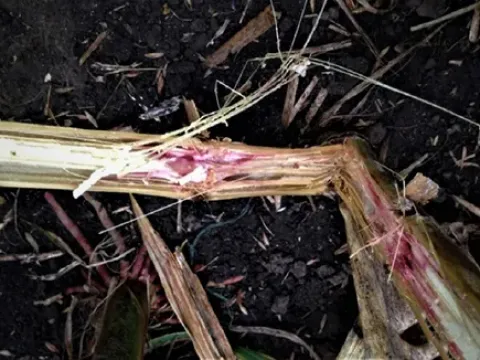
Fusarium head blight
Fusarium graminearum
Fusarium graminearum is an ascomycetous fungus from the Nectriaceae family, recognized as the primary pathogen responsible for Fusarium head blight (FHB) in cereal crops. It features both an asexual stage (anamorph Fusarium graminearum) and a sexual stage (teleomorph Gibberella zeae). The fungus typically produces orange-pink sporulation pads on affected plant parts.
What the section contains
Fusarium head blight
The mycelium of the fungus can vary in color from white to pink or reddish. As a soil-borne and residue-inhabiting parasite, it persists in the debris of crops like corn, wheat, and other grasses in the form of perithecia.
This phytopathogen exhibits high genetic diversity. During its development, it synthesizes hazardous secondary metabolites known as mycotoxins, including deoxynivalenol (DON) and zearalenone, rendering grain unsafe for consumption.
Dissemination occurs primarily through conidia and ascospores, which are spread by wind currents and rain splashes. Mass spore release often coincides with the flowering stage of cereal crops, which is when plants are most susceptible to infection.
The fungus invades plant tissues by directly penetrating the epidermis or entering through natural openings such as stomata. Once colonization begins, the pathogen grows rapidly, obstructing the plant's transport of water and nutrients within the spike.
The primary damage is inflicted upon small grain cereals including wheat, barley, rye, and oats. The pathogen poses a particularly significant threat to corn, where it causes ear rot and root rot.
Infection in wheat occurs during the flowering phase. The pathogen enters the spikelets, causing premature bleaching (dieback) before full maturity, which results in substantial yield losses.
On corn, the fungus colonizes ears, forming a dense fungal mat ranging from pink to brick-red in color. Affected kernels become shriveled, lose viability, and may contain toxic levels of mycotoxins harmful to both animals and humans.
Seedlings are also at risk: when seed-borne infection occurs, the fungus causes "black leg" and pre-emergence death, leading to sparse stands and the potential need for field reseeding in poor years.
Economic losses arise not only from reduced grain weight but also from compromised quality. The presence of mycotoxins above regulatory limits renders entire grain batches toxic and unsuitable for processing.
The development of the disease is most active under conditions of high humidity (exceeding 85%) and moderately warm temperatures, typically between 20°C and 28°C.
The critical window for wheat infection is the flowering phase. Anthers remaining in the spike serve as an ideal substrate for fungal spore germination and subsequent invasion.
The infection pressure builds up from autumn through early spring on plant residues left on the soil surface. Inadequate incorporation of crop stubble facilitates the accumulation of pathogen spores in the topsoil.
Rainfall during the heading period helps wash spores from stubble debris and facilitates their active dispersal to spikes. Even brief periods of high humidity during this phase can trigger an epidemic.
Throughout the summer, the pathogen spreads via secondary conidia, allowing it to rapidly infest fields whenever weather conditions remain favorable for fungal growth.
A hallmark sign on cereals is the premature bleaching of individual spikelets or the entire upper portion of the spike. A pink or orange conidial crust is frequently visible on affected structures.
Under humid conditions, small black dots—perithecia (fungal fruiting bodies)—may develop on the glumes. Inside these structures, spore-filled asci mature, ready for further dispersal.
Kernels within an infected spike are often covered in fungal growth; they appear shriveled, deformed, and exhibit a whitish or pinkish discoloration. The interior of such kernels contains dense fungal hyphae.
- Premature yellowing and drying of spikes during the milk stage.
- Presence of a pink or salmon-colored fungal mat on the spike rachis.
- Shriveled, deformed grain with visible fungal growth.
- Bleaching of the glume tissues.
On corn, infection is characterized by fungal mycelia colonizing the tip of the ear, leading to rotting kernels that may become matted together under a layer of mycelium.
Cultural practices include mandatory crop rotation, avoiding planting cereals after corn or other small grains. Deep plowing effectively reduces infection pressure by burying crop residues deeper into the soil.
Selecting varieties with high tolerance to Fusarium is a crucial management step. While no wheat variety is completely immune, choosing resistant genotypes significantly mitigates the risk of epidemics.
Chemical control focuses on applying fungicides during the flowering phase (start of heading). Effective active ingredients include triazoles, prochloraz, and combinations of these with strobilurins.
Seed treatment prior to planting protects seedlings from soil-borne infection, ensuring uniform emergence and reducing the primary inoculum source.
Optimizing harvest timing prevents the accumulation of mycotoxins. Timely harvest followed by rapid drying to below 14% moisture halts further fungal growth in the stored grain mass.