
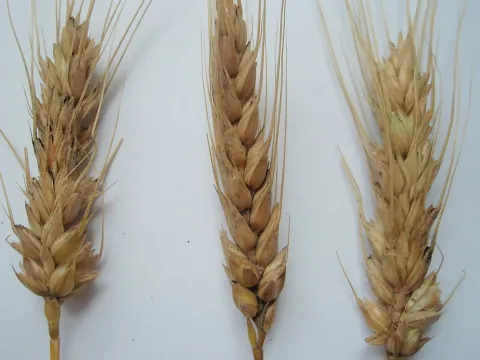
Fusarium culmorum
Fusarium culmorum
Fusarium culmorum is a soil-borne fungal pathogen classified within the genus Fusarium. It is recognized as a significant causative agent of various plant diseases, primarily affecting cereal crops.
What the section contains
Fusarium culmorum
The fungus is characterized by its ability to produce microconidia and macroconidia, as well as thick-walled chlamydospores. These chlamydospores enable the fungus to survive in the soil for several years, even in the absence of a host.
Colonies typically exhibit a cottony texture and can vary in color from pale pink to intense red or reddish-brown. The macroconidia are generally sickle-shaped with blunt ends, a key feature for laboratory identification.
This pathogen acts as a facultative parasite, meaning it can survive on organic matter in the soil while waiting for a suitable host plant to emerge, making it highly persistent in agricultural systems.
Its biological cycle is well-adapted to temperate climates, allowing it to remain active across various soil types and environmental conditions found in major grain-producing regions.
The pathogen primarily attacks small-grain cereals, including wheat, barley, rye, and oats. It is also a known pathogen of maize, contributing to stalk and ear rot issues.
The damage caused by Fusarium culmorum manifests as seedling blight, crown rot, and foot rot. These conditions weaken the plant by destroying the root system and the lower stem, often leading to premature plant death.
One of the most destructive aspects is Fusarium Head Blight (FHB), which results in shriveled grains and significantly lower yields. Infected grain often contains mycotoxins, which pose risks to both animal and human health.
The fungal infection disrupts the vascular system of the crop, inhibiting the transport of water and nutrients, which ultimately results in stunted growth and lodging of the mature crop.
Economic losses are compounded by the necessity of discarding infected harvests, which fail to meet quality standards for industrial grain processing or food production.
The disease cycle is initiated when spores germinate in the soil under favorable conditions. Optimal temperatures for fungal activity range between 12°C and 25°C, coupled with adequate moisture.
Infection cycles continue throughout the growing season. Seedlings are most vulnerable shortly after germination, as the fungus invades the roots and crown during early growth stages.
Spore dispersal is highly dependent on humidity and wind. Rain splashes play a critical role in moving spores from soil-borne debris to the wheat heads, especially during the flowering period.
The pathogen remains active as long as the host tissue is present or survives as saprophytes on crop residues in the soil, ensuring its survival from one harvest to the next.
Winter conditions generally force the fungus into a state of dormancy, though it resumes rapid development as soon as soil temperatures increase in the spring.
Early symptoms include yellowing and browning of the seedling tissues, followed by necrosis and rotting. Infected seedlings are often stunted and may die before or shortly after emergence.
In mature plants, a characteristic browning appears at the base of the stem. As the disease progresses, the plant may exhibit premature bleaching of the head, a condition often referred to as "white heads."
In humid environments, pinkish or orange fungal mycelia and masses of spores can be observed on the surface of the infected stems or ears.
- Rotting and necrosis of primary roots.
- Dark brown lesions at the stem base (foot rot).
- Premature ripening and shriveled grain.
- Pink or orange mold on ears under high humidity.
- Sparse plant stands and poor emergence.
In severe cases, the entire root system may decay, causing the plant to lose its anchoring in the soil, which makes it easily pulled from the ground during harvest preparation.
The most effective management strategy is crop rotation, ideally incorporating non-host crops to break the cycle of the fungus in the soil and reduce inoculum levels.
Seed treatment using systemic fungicides is a mandatory practice for many growers to protect germinating seeds and young seedlings from initial soil-borne infections.
Good agricultural practices, such as proper tillage and the incorporation of crop residues, help in the decomposition of materials that harbor the fungus, thereby limiting its spread.
Selecting and planting resistant cultivars remains one of the most sustainable methods to minimize the impact of the pathogen on final crop yields.
During high-risk periods, such as warm and wet flowering windows, foliar fungicide applications on the heads are necessary to suppress the development of head blight.