
Late blight
Family
Late blight is caused by the oomycete Phytophthora infestans, an organism historically classified as a fungus but now recognized as a member of the kingdom Chromista. It is a highly destructive pathogen that requires moisture to infect.
What the section contains
Late blight
The pathogen reproduces asexually through motile zoospores and sexually through oospores. Oospores allow the pathogen to survive in the soil for years, serving as a reservoir for recurring infections.
Infection typically begins from infected seed potatoes, volunteer plants, or contaminated soil. Once established, sporangia are easily dispersed by wind and rain splash to nearby healthy plants.
The incubation period is extremely short, often between 3 to 5 days under optimal conditions of high humidity and moderate temperatures, leading to rapid spread across entire fields.
P. infestans is known for its high genetic plasticity. New populations and mating types continue to emerge, making it difficult for breeders to maintain long-term genetic resistance in crops.
The disease primarily attacks the Solanaceae family, with potatoes and tomatoes being the most economically significant hosts. It is famous for causing the Great Famine in Ireland due to its ability to destroy entire crops.
On potatoes, late blight affects foliage, stems, and tubers. Infected tubers stored in cool, moist conditions will rapidly decay, potentially leading to total loss of harvested stocks during winter storage.
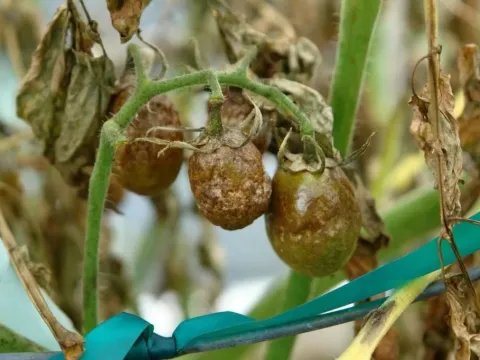
Tomato plants are highly susceptible, with infections occurring on leaves, stems, and fruit. Once the pathogen reaches the fruit, it causes firm, dark lesions that quickly progress to total fruit rot.
Other solanaceous plants, such as eggplant, peppers, and wild nightshades, can harbor the pathogen, acting as "green bridges" that maintain the disease cycle throughout the growing season.
Without intervention, late blight can cause crop yield losses ranging from 50% to 100%. This high level of damage necessitates rigorous scouting and preventive chemical applications in commercial farming.
Late blight flourishes in cool, wet weather. Temperatures between 15°C and 22°C combined with high relative humidity or leaf wetness (dew, fog, rain) are optimal for disease development.
Mid-to-late summer is the most critical time for outbreaks, particularly during periods of frequent rainfall and moderate heat, which provide perfect conditions for the pathogen's sporulation.
Early season outbreaks can occur if infected seed tubers are planted. The pathogen can grow systemically within the plant as it emerges from the soil, creating a point source for field-wide infection.
Extremely hot and dry weather can inhibit the spread of the pathogen, but it does not necessarily kill the organism, which can survive in micro-environments until conditions improve.
Predictive modeling based on weather data is an essential tool for modern agriculture, allowing farmers to apply fungicides only when the risk of infection is statistically high.
The first symptoms are small, water-soaked spots on leaves that quickly turn dark brown or black. A white, fuzzy growth of sporangia often appears on the undersides of these lesions during humid weather.
Stems develop dark, elongated lesions that weaken the plant structure, often causing the stems to snap. Entire sections of the plant may wither and die within a matter of days.
On tomato fruits, symptoms appear as firm, dark-colored, slightly sunken patches. As the infection progresses, secondary bacteria often colonize the lesion, resulting in a foul-smelling, mushy rot.
Potato tubers exhibit reddish-brown, dry, granular rot under the skin. Infected areas on the tuber surface often appear as sunken, purplish-grey patches that expand during storage.
- Rapidly spreading necrotic lesions on foliage.
- Visible white mold under high-humidity conditions.
- Characteristic "burnt" appearance of the foliage canopy.
Integrated Pest Management (IPM) is the most effective approach. This includes planting certified disease-free seed tubers and choosing varieties with known field resistance to the pathogen.
Cultural practices are vital: ensure proper drainage, remove and destroy all infected plant debris, and practice crop rotation with non-solanaceous crops for at least 3 years.
Chemical control relies on the timely application of fungicides. Preventive sprays are more effective than curative ones, especially when weather forecasts predict extended periods of rain.
Managing the plant canopy to improve air circulation helps foliage dry faster, reducing the time available for zoospores to infect the plant tissue.
Harvesting should be delayed until the foliage is fully dead to prevent tuber contamination. After harvest, tubers should be stored in well-ventilated, cool, and dry environments to inhibit late blight development.