
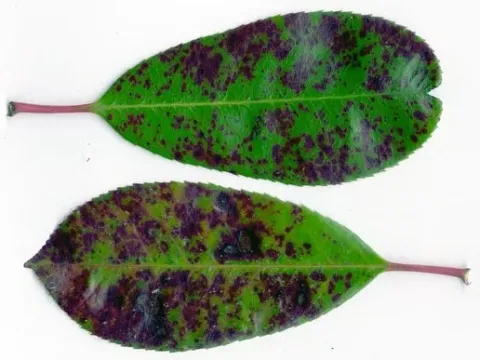
Entomosporium leaf spot
Entomosporium mespili
The causative agent of the disease is the fungus Entomosporium mespili, belonging to the class Ascomycetes. It is characterized by the production of unique star-shaped conidia that facilitate efficient dispersal through water splashes and wind currents.
What the section contains
Entomosporium leaf spot
The pathogen primarily overwinters as mycelium or stroma in infected fallen leaves on the ground. When spring temperatures rise and moisture levels increase, the fungus produces conidia, which serve as the primary inoculum for new infections.
Infection occurs when spores land on susceptible host tissue, such as young leaves or succulent shoots, and germinate under humid conditions. The germ tubes penetrate the epidermis, allowing the mycelium to colonize the intercellular spaces of the plant tissue.
During the growing season, multiple cycles of conidial production occur. High relative humidity and moderate temperatures are the most favorable environmental conditions for rapid disease progression and extensive secondary spread throughout the orchard.
Temperature plays a crucial role in the development of the pathogen. While growth can occur over a range of temperatures, the optimal range for mycelial expansion and sporulation is between 15 and 22 degrees Celsius.
Entomosporium leaf spot affects a wide variety of plants within the Rosaceae family. Susceptible hosts include hawthorn, pear, quince, juneberry, photinia, and medlar. The disease is particularly destructive in nursery settings.
The primary damage results from premature defoliation, which occurs when leaf spots become widespread. This early loss of foliage disrupts the plant's ability to photosynthesize, reducing overall vigor and winter hardiness.
Infection of succulent shoots and twigs leads to the formation of necrotic lesions and ulcers. These lesions can obstruct the vascular system, causing stunted growth, twig dieback, and in severe cases, the death of young seedlings.
Fruit quality is significantly compromised by the disease. Small, dark, sunken lesions develop on the surface of the fruit, making them aesthetically unappealing and susceptible to rot, which reduces marketability and storage life.
Chronic infection over several seasons leads to severe decline in host health. Trees that have been severely defoliated for consecutive years show poor fruit production and are highly susceptible to secondary stresses like drought or cold injury.
Symptoms typically begin as small, circular, reddish-brown spots on the leaves. As the infection progresses, these spots may enlarge and coalesce, resulting in large, necrotic areas across the leaf surface.
A diagnostic characteristic is the presence of small, black, raised cushions, known as acervuli, in the center of the spots on both the upper and lower leaf surfaces. These structures produce the fungal spores.
When the pathogen infects petioles and young stems, it creates elongated, dark, sunken lesions. These can lead to wilting of the attached foliage and cause the stems to crack or snap, especially under windy conditions.
Severe leaf infections often result in yellowing and premature dropping of the foliage. By mid-summer, heavily infested trees may appear sparse, with most of the foliage concentrated only on the tips of the branches.
On the fruit, the lesions appear as dark, crater-like spots. As the fruit continues to expand, these spots may crack, providing entry points for other decay-causing organisms to further degrade the fruit quality.
Sanitation is the most critical management strategy. Carefully raking and destroying fallen leaves is essential to eliminate the primary inoculum source that survives the winter near the host plants.
Chemical control involves the application of fungicides during the growing season. Protective copper-based sprays or systemic fungicides such as those in the triazole or strobilurin classes are effective when applied at the correct intervals.
Applications should be timed to coincide with critical periods of vulnerability, such as bud break, flowering, and periods of high rainfall. Consistent monitoring is required to adjust spraying schedules based on local weather conditions.
Cultural practices are vital for suppression. Improving airflow and light penetration by pruning trees and avoiding overhead irrigation can significantly reduce the humidity levels that the fungus requires for infection.
Selecting disease-resistant cultivars or varieties is the most sustainable approach for long-term control. In areas with high disease pressure, planting resistant species minimizes the reliance on intensive chemical interventions.