
Southern corn leaf blight
Drechslera maydis
Southern corn leaf blight is caused by the fungus Drechslera maydis (syn. Bipolaris maydis), belonging to the kingdom Fungi and the genus Drechslera. It is a major pathogen responsible for significant yield losses in maize production worldwide.
What the section contains
Southern corn leaf blight
The fungus is a facultative parasite that survives between growing seasons as mycelium and conidia on infected crop residue, soil, and seeds. It spreads primarily through wind-borne spores that settle on host tissues.
In terms of taxonomy, the pathogen is an Ascomycete that reproduces primarily through conidia. The morphology of these spores is crucial for diagnostic identification in pathological laboratories.
The infection process is rapid and starts when the conidia land on a leaf surface and germinate in the presence of free water. The germ tube then penetrates the epidermis to colonize the leaf tissue.
Environmental conditions such as high humidity and moderate temperatures significantly influence the pathogen's ability to produce secondary cycles of infection during the growing season.
This disease primarily attacks maize leaves, though in severe cases, it can spread to leaf sheaths, stalks, and husks. The damage directly impacts the plant's ability to perform photosynthesis.
The loss of leaf area due to necrotic spots prevents the plant from producing sufficient carbohydrates to fill the kernels, resulting in lower grain weight and stunted ears.
Beyond yield reduction, the fungus can infect the kernels, leading to ear rot. This not only lowers the quantity of the harvest but also drastically reduces the quality of the corn.
In highly susceptible hybrid varieties, the blight can cause widespread leaf death, leading to plant lodging and difficulty in machine harvesting, which further decreases economic returns.
Total yield losses can be substantial, especially in regions with high rainfall and warm climate conditions during the late stages of crop development.
Southern corn leaf blight typically emerges during the mid-to-late season. The infection often intensifies after the tasseling phase when the canopy is dense and retains moisture.
Optimal development occurs at temperatures between 20°C and 30°C. Frequent rainfall, heavy dew, or prolonged periods of high relative humidity are essential for the spores to germinate and infect.
The disease cycle can repeat every few days under ideal conditions, allowing the pathogen to sweep across a field and destroy the entire photosynthetic capacity of the crop in a short time.
As the season progresses, the fungus accumulates on the lower leaves and gradually moves upward, facilitated by rain splashing and strong winds during storm events.
While the blight can occur early in the season, it is most destructive when it reaches the upper leaves of the plant just before or during the grain-filling stages.
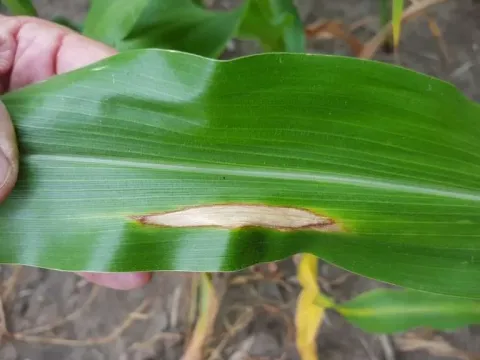
Symptoms initially appear as small, pale-green or yellow spots, which eventually enlarge into characteristic elongated, tan or brown lesions with dark margins.
- Lesions that are rectangular or spindle-shaped, confined by leaf veins.
- Development of dense, olive-brown fungal sporulation on the surface of the lesions.
- Lesion coalescence, where multiple spots merge to kill large sections of the leaf.
- Grayish-black mold visible on the ears and kernels in severe infection cases.
- General chlorosis and rapid wilting of the plant canopy.
The necrotic areas can eventually cover the entire leaf surface, giving the field a withered and burned appearance before the crop reaches maturity.
Planting resistant or tolerant corn hybrids is the most effective and sustainable method for managing southern corn leaf blight on a large scale.
Crop rotation with non-host plants helps break the life cycle of the fungus, while tillage practices that bury infected residue speed up the natural decomposition of the pathogen's substrate.
Chemical control involving foliar fungicides, particularly strobilurins and triazoles, is recommended when environmental conditions favor disease development and scouting confirms the presence of infection.
Seed treatment with systemic fungicides provides an important initial shield, protecting emerging seedlings from soil-borne and seed-borne inoculum during the early establishment phase.
Integrated pest management, combining genetic resistance with timely scouting and judicious fungicide use, remains the standard approach for protecting crop productivity.