
Diaporthe rot of cucurbits
Diaporthe cucurbitae
The causal agent is the fungus Diaporthe cucurbitae (anamorph Phomopsis cucurbitae), a member of the Ascomycota phylum. This pathogen is a specialized parasite that attacks a wide variety of species within the Cucurbitaceae family.
What the section contains
Diaporthe rot of cucurbits
The fungus overwinters in the soil or on infected plant debris as pycnidia and perithecia, acting as primary inoculum. Spores are primarily disseminated by water splash during rain events, wind, and mechanical transfer via equipment.
Optimal conditions for pathogen development include high relative humidity (above 85%) and moderate temperatures between 20°C and 25°C. Tissue damage from pests or mechanical operations creates entry points, facilitating successful infection.
The life cycle involves the production of pycnospores which rapidly colonize host tissues under conducive environments. The fungus can complete multiple infection cycles throughout a single growing season, leading to rapid field-wide dissemination.
Economic losses are significant as the disease affects vegetative organs and fruit, leading to total yield reduction and post-harvest decay. The destruction of stem tissue often causes plant wilting and premature senescence.
This pathogen impacts major crops such as pumpkins, squashes, cucumbers, melons, and watermelons. It can affect plants at any growth stage, ranging from young seedlings in nurseries to mature fruits ready for harvest.
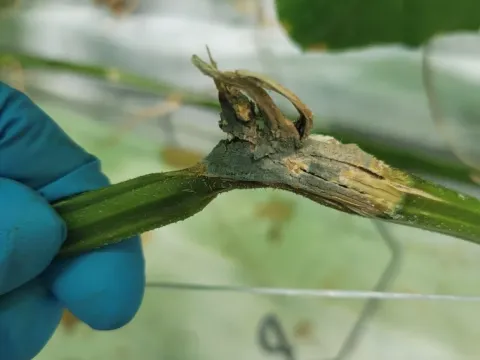
Initial infection manifests as small, water-soaked spots that expand into necrotic lesions. A diagnostic feature is the appearance of numerous minute black fruiting bodies (pycnidia) embedded within the lesion tissue on stems and fruit surfaces.
Infected fruits typically develop soft or dry rot, with the flesh turning brown and emitting a characteristic odor. In humid environments, a white mycelial mat may develop over the surface of the fruit lesions.
Management strategies focus on cultural practices, including a mandatory 3-to-4-year crop rotation that excludes cucurbits to reduce soil inoculum. Sanitation remains the most effective tool to prevent widespread infection within a field.
- Removal and deep burial of all infected plant residues.
- Utilization of disease-free certified seeds for planting.
- Application of systemic or contact fungicides during periods of high humidity.
- Maintaining optimal irrigation schedules to prevent excessive leaf and soil wetness.