
Davidiella macrocarpa
Davidiella macrocarpa
Davidiella macrocarpa belongs to the kingdom Fungi, phylum Ascomycota, genus Davidiella. This microscopic ascomycete fungus is frequently identified by its conidial stage (anamorph), known as Cladosporium macrocarpum. It is a typical representative of pathogenic and saprotrophic mycobiota.
What the section contains
Davidiella macrocarpa
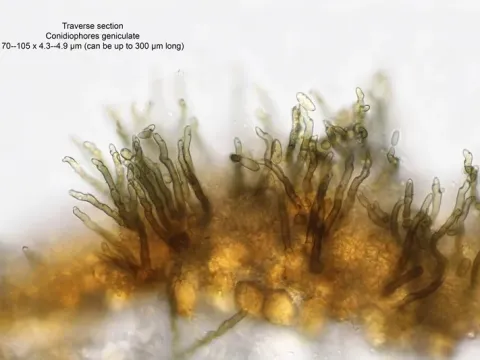
The mycelium of the fungus develops inside plant tissues or on their surface, forming dark, almost black colonies. Sporulation is abundant, and conidiophores often branch to form chains of conidia. Visually, the colonies may appear as moldy patches of varying intensity.
The fungus is characterized by distinct polymorphism, which complicates identification without laboratory analysis. To accurately determine the species, specialists use light microscopy to evaluate spore morphology and the structure of conidiophores.
The spread of the pathogen occurs primarily through the air, via spores carried by the wind. Under favorable conditions, the fungus quickly colonizes damaged or weakened plant tissues, transitioning from saprotrophic nutrition to parasitism.
The life cycle development of the fungus depends directly on substrate availability. As a phytopathogen, it is often found on plant residues, from which spores reach young, vegetative shoots of agricultural crops.
The pathogen affects a wide range of agricultural and ornamental crops, including vegetables, cereals, and fruit-bearing plants. The fungus poses a significant risk to tomatoes, cucumbers, and certain grains when agronomic practices are neglected.
Leaves, fruits, and stems are most commonly affected. In conditions of high humidity, the fungus can cause severe damage to vegetative organs, leading to premature wilting and a reduction in photosynthetic activity.
On fruits, the development of the pathogen causes necrotic spots, rendering the produce unmarketable. This significantly reduces the market value of the harvest and shortens post-harvest storage life.
The pathogen can also affect seeds, facilitating the spread of infection to new areas when low-quality planting material is used. Infected seeds exhibit poor germination and produce weak seedlings.
Pathogenicity manifests as a systemic weakening of plant immunity. As a result of prolonged fungal impact, the plants become susceptible to secondary infections, which complicates diagnosis and harvest protection.
The fungus shows peak activity during periods of high humidity and moderate temperatures. Optimal infection conditions often coincide with the flowering and active fruiting stages of agricultural crops.
Primary infection centers are usually observed in spring, when soil and air temperatures rise to +15...+20 degrees Celsius. Overwintered spores begin to germinate on plant debris, from which the infection pressure gradually increases.
During the summer, with the alternation of rain and warm sunny days, conidia dispersal occurs at its most intensive rate. This is when agronomists typically record disease outbreaks in fields and greenhouses.
In autumn, the pathogen's activity persists until the onset of frost. As temperatures drop, the fungus enters a dormant state, forming specialized structures or persisting as mycelium in plant residues until the next season.
To prevent massive infection, it is crucial to monitor crop health during the "wet windows" in the vegetation cycle. Early detection of initial symptoms allows for effective prevention of epiphytotics.
The first symptoms of infection are small chlorotic spots, which eventually turn dark brown or almost black. A light halo often forms around the spots, indicating the plant's defense response against the fungal mycelium.
- Appearance of a dark "velvety" coating on the underside of leaves.
- Deformation and curling of affected leaf blades.
- Formation of deep necrotic lesions on stems and fruits.
- Premature leaf drop in the lower part of the plant.
When tomato or cucumber fruits are affected, deformation and rot development in mechanical damage sites are observed. The infection can penetrate deep into tissues, causing the degradation of cell walls.
A characteristic feature is the focal nature of disease spread across the field. Spots may merge, creating large necrotic areas, which leads to the complete death of individual leaves or entire shoots.
Agronomic measures remain the basis of control: it is essential to strictly follow crop rotation and timely remove plant residues from the field, where the fungus overwinters. Deep plowing of the soil is recommended.
To protect crops, broad-spectrum fungicides based on copper, triazoles, or strobilurins are used. It is important to rotate preparations to prevent the pathogen from developing resistance.
In greenhouses, maintaining an optimal ventilation regime to reduce air humidity is critical. Controlling the microclimate is the most effective way to prevent the development of Davidiella macrocarpa.
Seeds should be treated with certified dressings before planting. This eliminates the introduction of infection to clean areas and ensures the protection of young seedlings during the initial growth stage.
Biological control methods include the use of preparations based on antagonistic fungi, such as Trichoderma. These agents suppress pathogen development while remaining safe for the environment and the harvest.