
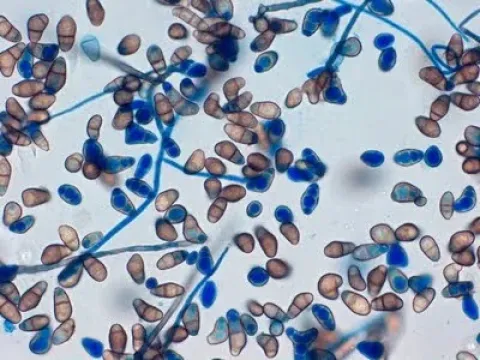
Curvularia senegalensis
Curvularia senegalensis
Curvularia senegalensis is an anamorphic fungus belonging to the phylum Ascomycota, class Dothideomycetes, order Pleosporales, and family Pleosporaceae. This phytopathogen acts as a soil-borne fungus with a broad host range among agricultural crops.
What the section contains
Curvularia senegalensis
The mycelium of the fungus is characteristically dark, common among dematiaceous hyphomycetes. The primary diagnostic feature is its multicellular, curved conidia produced on conidiophores, which are easily disseminated by wind, rain splashes, or contaminated agricultural equipment.
In laboratory conditions, the fungus forms dense, dark colonies that grow rapidly on standard media such as potato dextrose agar. Precise identification requires microscopic examination, focusing on the morphology, size, and septation of the conidia.
The biology of this fungus is closely linked to a saprotrophic existence in the soil, where it survives on decaying plant matter. It shifts to a pathogenic lifestyle when conditions favor infection, targeting weakened or stressed plant tissues.
It is classified as an opportunistic pathogen, meaning it has the potential to infect seeds, seedlings, and vegetative parts of crops, leading to tissue necrosis and stunted growth throughout the growing season.
Curvularia senegalensis poses a significant threat to cereal crops, including wheat, maize, and rice. Beyond cereals, the fungus has been documented on legumes and vegetables, causing seedling blight and root rot.
The most substantial damage occurs during the germination stage, where the fungus causes seed mold. This significantly reduces seed viability, often killing embryos before they emerge from the soil surface.
During the vegetative growth phase, leaves and stems are attacked. The infection manifests as necrotic spots that enlarge and coalesce, covering large areas of the leaf surface and severely limiting the plant's photosynthetic capacity.
The fungus can also infect heads or ears, causing blackening of glumes and grain shriveling. This directly impacts both the quantity and quality of the harvested product, causing financial losses.
In high-humidity environments, the fungus may infect harvested fruits or grains during storage, leading to decay and spoilage, which creates significant management challenges for post-harvest operations.
Development of the pathogen is most active during periods of high relative humidity and moderate to high temperatures (optimal range of 25–30°C). In tropical and subtropical regions, the fungus remains active throughout the year.
In temperate climates, infections most frequently occur during late summer, when ambient temperatures and intermittent rainfall facilitate massive conidia production and secondary spreading.
The life cycle involves the formation of conidia, which spread via wind or water droplets onto susceptible host tissues. Spore germination is efficient and rapid whenever free moisture is present on the plant surface.
The primary inoculum consists of infected seeds and crop residues in the soil, where the fungus persists as chlamydospores or dense mycelial mats, providing a stable reservoir for seasonal infections.
The severity of an outbreak is strongly correlated with weather patterns; prolonged rainfall during anthesis and grain filling promotes widespread infection of the heads and ears.
The initial signs of infection include the appearance of chlorotic spots that transition into necrotic lesions, often accompanied by a yellow halo. These lesions turn dark brown or black due to the dense fungal sporulation.
Root infection is characterized by blackening and necrosis of the secondary root system, leading to wilting symptoms in the canopy even when soil moisture is otherwise sufficient for the plant.
On seeds, the pathogen appears as a dark grey or black powdery/fluffy coating that covers the pericarp. This symptom is easily identifiable during phytosanitary inspections of seed lots.
Internal tissue destruction causes structural weakness, leading to brittle stems or leaf breakage at the sites of larger necrotic lesions, which can eventually reduce the plant's lodging resistance.
- Blackening of the root collar and primary roots.
- Development of dark necrotic leaf spots.
- Mold growth on seeds during storage.
- Decreased seed germination energy.
The foundation of control is the use of high-quality, fungicide-treated seeds. Systemic fungicides, particularly azoles and benzimidazoles, are effective in suppressing fungal development during the early stages of plant growth.
Agronomic practices are essential; crop rotation is highly effective in disrupting the pathogen's life cycle. It is crucial to avoid continuous cropping of highly susceptible hosts like maize or wheat.
Deep plowing of crop residues or their complete removal helps reduce the soil inoculum reservoir. Weed management is also vital, as many weed species act as alternative hosts for the fungus.
During the growing season, if symptoms appear, fungicide applications involving strobilurins or triazoles can provide reliable protection for the canopy and prevent further disease progression.
Optimizing plant nutrition, especially balanced potassium application, increases the resilience of crops to fungal penetration by strengthening cell wall integrity and overall plant vigor.