
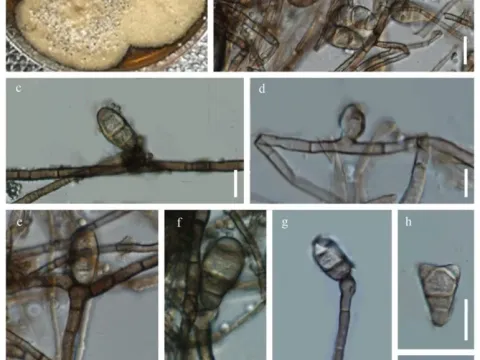
Curvularia lunata
Curvularia lunata
Curvularia lunata is a fungus belonging to the kingdom Fungi, specifically the genus Curvularia. It is a filamentous ascomycete known as a significant plant pathogen capable of infecting numerous agricultural crops worldwide.
What the section contains
Curvularia lunata
The fungus is characterized by the production of dark brown to black colonies when cultured. Its conidia are multi-celled and typically display a curved or "crescent" shape, which serves as a diagnostic feature under microscopic examination.
As a facultative parasite, this organism survives well in the soil as a saprophyte on crop debris. It possesses a high ability to produce various metabolites and mycotoxins that assist in infecting the host plant by compromising its cellular integrity.
The species exhibits significant phenotypic and genotypic diversity, allowing it to adapt to different environmental stresses and host resistance mechanisms across various climatic zones.
Modern diagnostics often involve microscopic analysis of spore structure along with molecular techniques like PCR to distinguish Curvularia lunata from related species in the complex, ensuring accurate identification for research and management.
Curvularia lunata causes a wide range of diseases, including leaf spots, seedling blight, root rots, and fruit/grain decay. It severely impacts crops such as maize, wheat, rice, sorghum, cotton, and various vegetable plants.
In maize, the fungus is known to cause "Curvularia leaf spot" and ear rot. The infection of ears is particularly devastating, leading to grain quality reduction, weight loss, and the contamination of grain with harmful mycotoxins.
Root rot infections compromise the plant's ability to take up nutrients and water. This often results in stunted growth, yellowing, and eventually the death of young seedlings or weakened adult plants.
Seed-borne transmission is a critical pathway for the spread of the pathogen. Infected seeds often show poor germination rates and produce weak seedlings that are unable to establish themselves properly in the field.
Post-harvest damage is also significant. During storage, if the moisture content of the stored product is not maintained at low levels, the fungus rapidly colonizes the produce, causing discoloration and degradation of nutritional value.
The development of diseases caused by Curvularia lunata is highly dependent on humidity and temperature. Warm, moist conditions with temperatures ranging from 25°C to 30°C are ideal for the rapid growth and sporulation of the fungus.
Primary infections occur via spores or mycelium that have overwintered in infected crop residues or within the soil. These inocula are disseminated by wind, splashing rain, and agricultural equipment.
Secondary cycles occur throughout the growing season whenever there is prolonged leaf wetness or high atmospheric humidity. This allows the pathogen to multiply and spread across the field, leading to severe outbreaks.
Plants under stress are significantly more susceptible to infection. Environmental factors like drought, nutrient deficiency, or insect damage can weaken the plant's natural defense systems, facilitating the entry and colonization of the fungus.
As temperatures drop or conditions become unfavorable, the pathogen enters a dormant phase. It forms persistent structures in the soil, ensuring its survival from one growing season to the next.
Initial symptoms on leaves appear as small, chlorotic spots that eventually turn brown or black, often with a yellow halo around the lesion. As the disease progresses, these spots expand and may coalesce, leading to large necrotic areas.
Infected stems often develop dark streaks and can become brittle, reducing the plant's structural strength and increasing the risk of lodging. A dark, velvety mass of fungal spores is often visible on the surface of the lesions.
When the ears of corn are infected, kernels may become blackened and covered with a dark moldy growth. In advanced stages, the entire ear can rot, showing distorted growth and a distinct, unpleasant odor.
- Chlorotic and necrotic spots on foliage.
- Presence of black, velvety spore masses on tissues.
- Weakening and lodging of stems.
- Poor grain fill and discoloration of seeds.
- Reduced seedling vigor and damping-off.
The primary control strategy involves the use of high-quality, certified, and disease-free seeds. Seed treatment with systemic fungicides is an effective measure to protect the plant during its most vulnerable emergence phase.
Implementing a robust crop rotation plan is essential to disrupt the pathogen's life cycle. Avoiding susceptible crops in the same field for several consecutive years helps reduce the inoculum levels in the soil.
Good field sanitation is crucial. Deep plowing and the thorough incorporation of crop residues into the soil promote the decomposition of infected debris, which significantly lowers the risk of primary infection in the following season.
Foliar application of fungicides may be necessary in high-risk areas during periods of favorable weather for the fungus. Integrated pest management (IPM) practices should be followed to minimize the overall disease pressure.
Maintaining optimal soil fertility, particularly balanced nitrogen and potassium levels, helps plants build stronger defenses. Avoiding excessive nitrogen application prevents overly lush growth that is more prone to fungal penetration.