
Celery mosaic virus
Apium virus
Description
How to identify
Celery mosaic virus (CeMV) is a viral plant pathogen that belongs to the Potyvirus genus within the Potyviridae family. It is a non-persistently transmitted virus primarily spread by aphids.
The virus consists of flexuous filamentous particles measuring approximately 700–800 nm. It does not transmit through seeds, which allows for better management via quarantine and sanitation practices.
As an obligate parasite, CeMV relies on living host tissues to replicate. It persists in perennial weeds and volunteer plants, serving as an overwintering reservoir for the infection.
Identification is based on characteristic mosaic patterns and leaf malformations. For professional diagnostics, researchers use ELISA (Enzyme-Linked Immunosorbent Assay) or PCR to confirm the presence of the virus.
Understanding the transmission biology is crucial: since the virus is non-persistent, aphids can transmit it after feeding on an infected plant for only a few seconds, making control challenging.
What it damages
The virus primarily affects members of the Apiaceae family, with celery (leaf, stalk, and celeriac) being the most economically significant host for this pathogen.
Other host crops include parsley, parsnip, carrots, and dill. In these crops, the virus leads to reduced vigor, stunting, and significantly decreased yield potential.
The economic damage is caused by the loss of cosmetic quality, as infected plants become deformed and unmarketable, leading to high rejection rates at harvest.
Beyond crop loss, the virus interferes with plant physiology, reducing the ability of the crop to photosynthesize effectively, which limits total biomass accumulation.
In regions with high aphid activity, the virus can lead to widespread outbreaks, potentially destroying a large percentage of the crop if left unmanaged during the early growth stages.
Signs of infestation
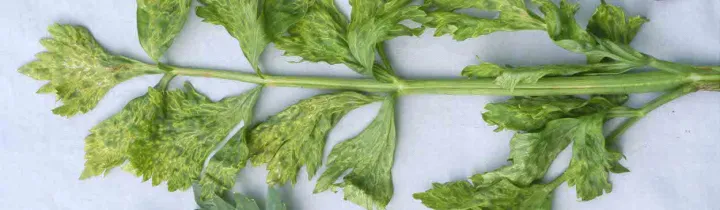
Initial symptoms include a light green or yellow mottle pattern on young leaves, which eventually develops into a systemic mosaic appearance across the foliage.
Leaves exhibit significant curling and distortion, often becoming crinkled and stunted. The typical symmetry of the plant canopy is lost, leading to a sprawling or clumped habit.
Leaf petioles become shorter and brittle, with a twisted appearance. This makes the celery stalks undesirable for the fresh produce market due to their poor texture and shape.
In celeriac, the root development is severely impacted, resulting in small, woody, and misshapen roots that lack the commercial quality required for sale.
Early-stage infection leads to general plant stunting, where the entire plant remains significantly smaller than healthy individuals, resulting in uneven crop stands.
Control measures
The most effective strategy is the implementation of spatial isolation, keeping new celery fields as far as possible from older plantings or wild Apiaceae weeds.
Strict aphid control is essential during the early stages of crop development, as managing the vector population is the primary way to minimize the spread of non-persistent viruses.
Sanitation measures, including the removal of weeds and volunteer celery plants near field margins, help eliminate the primary inoculum sources for the virus.
Growers should prioritize the use of resistant or tolerant cultivars when available to minimize the impact of viral infections on overall field performance.
Consistent field monitoring allows for the early detection and removal of infected plants, which can help reduce the virus spread rate during the growing season.
Causes diseases · 1
Discussion
No discussions yet — be the first.