
Grapevine virus
Grapevine virus
Description
How to identify
Grapevine viruses are a complex group of phytopathogens that colonize the vascular system of the vine, disrupting nutrient transport and physiological processes. The most economically damaging include Grapevine Leafroll-Associated Viruses (GLRaV) and Grapevine Fanleaf Virus (GFLV).
These pathogens represent various taxonomic groups, such as Ampelovirus, Vitivirus, and Nepovirus. As obligate parasites, they rely entirely on the host's cellular machinery to replicate, making them systemic throughout the infected plant.
The primary pathway for virus transmission is the planting of infected nursery stock, including scions and rootstocks. Because many infections remain asymptomatic for long periods, the virus can spread undetected across large plantations.
Natural transmission occurs through vectors, including soil-borne nematodes, mealybugs, and scale insects. Furthermore, human activities such as grafting or mechanical pruning with unsterilized tools represent a high risk of virus transmission between healthy vines.
Accurate identification requires laboratory analysis. Techniques such as Enzyme-Linked Immunosorbent Assay (ELISA) and Polymerase Chain Reaction (PCR) are the gold standard for detecting viral genetic material in grapevine tissues.
What it damages
Viral infections affect nearly all grapevine varieties, causing severe systemic decline. The damage is cumulative, leading to the gradual loss of productivity, reduced vigor, and shortened lifespan of the vineyard.
Infected vines exhibit compromised immunity, making them significantly more susceptible to environmental stresses such as frost, drought, and secondary opportunistic pathogens. This results in the progressive dieback of the plant framework.
Yield losses are substantial, often ranging from 30% to over 80%. Fruit quality is severely degraded, characterized by uneven berry ripening, lower sugar levels, and poor color development, which renders the harvest unsuitable for quality winemaking.
Fanleaf virus, specifically, causes distinct architectural damage to the vines, including stunted growth, zigzag-patterned canes, and double nodes. These structural abnormalities significantly reduce the trellis capacity and photosynthetic area.
The economic impact of viral infection is profound, as it frequently necessitates the complete removal and replanting of entire vineyard blocks, leading to high capital losses for producers.
When it appears
Symptoms are most visible during the active growing season, particularly from the bloom stage through fruit maturation. During the winter months, the viruses persist in the vine's woody tissue in a dormant state.
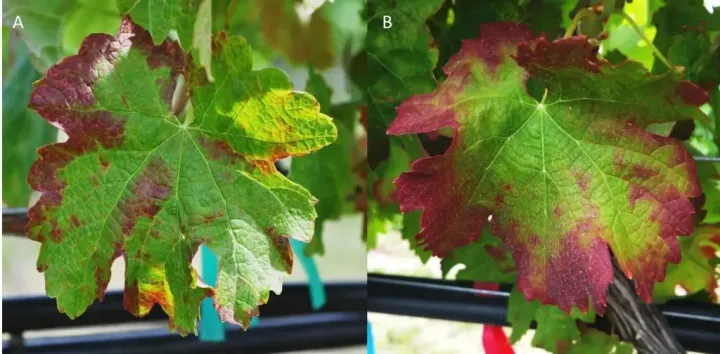
Leafroll symptoms typically manifest in late summer, showing a distinctive reddening or yellowing of the leaf blade while the veins remain green. This color change is a classic diagnostic marker that intensifies as harvest approaches.
Vector activity is highly seasonal and temperature-dependent. The movement of nematodes in the root zone and the migration of mealybugs occur primarily during the warmer months, coinciding with the peak period of potential secondary virus spread.
Environmental conditions that favor the rapid proliferation of insect vectors, such as mild, moist spring weather, indirectly increase the rate of viral spread within the vineyard.
Scouting for symptoms is most effective between mid-summer and harvest, when the combination of foliage color changes and structural abnormalities is at its most diagnostic level for an agronomist.
Signs of infestation
While symptoms vary by cultivar and virus strain, common indicators of viral degeneration in vineyards include the following features:
- Interveinal chlorosis or reddening of the leaves.
- Rolling of leaves, typically curling downwards.
- Distorted and asymmetrical leaf shapes.
- Shortened internodes and zigzag growth patterns on shoots.
- Poor fruit set, small berry size, and significant cluster straggling.
Control measures
There are no chemical curative treatments to eradicate a virus once it has established itself in a woody vine. Consequently, preventative measures are the only effective strategy for long-term vineyard health.
Establishing new vineyards with certified, virus-tested planting material is the foundational defense. Nurseries must adhere to strict indexing programs to ensure propagation material is free of the most damaging viral strains.
Controlling vectors is critical for containment. Management programs include soil fumigation or solarization to reduce nematode populations and the application of systemic insecticides to control mealybugs and scale insects.
Sanitation protocols must be strictly enforced. Pruning equipment and grafting tools should be disinfected using appropriate solutions after working on each individual vine to prevent mechanical transmission of the virus.
If an infected vine is identified, immediate rogueing (removal of the plant and its root system) is recommended to prevent the pathogen from spreading to neighboring vines. Maintaining high nutritional and water management standards can also help prolong the productivity of partially stressed vines.
Discussion
No discussions yet — be the first.