
Chickpea luteovirus
Chickpea luteovirus
Description
How to identify
Chickpea luteovirus (CpLV) belongs to the family Luteoviridae and the genus Polerovirus. It is a non-enveloped plant virus with a single-stranded RNA genome that specifically colonizes the phloem tissue of the host plant.
As an obligate parasite, this virus relies entirely on the host plant and specific insect vectors for survival and propagation. It cannot persist in the soil or be transmitted through physical contact with infected plant residues.
The virus is primarily transmitted by aphids, such as the pea aphid (Acyrthosiphon pisum). Transmission is persistent; once an aphid acquires the virus by feeding on infected phloem, it remains a carrier for the remainder of its lifespan.
There is no evidence of seed transmission or mechanical transmission of Chickpea luteovirus in legumes. Long-distance spread is mainly driven by the movement of winged aphid populations carried by wind currents.
Accurate identification requires laboratory analysis, such as ELISA (Enzyme-Linked Immunosorbent Assay) or RT-PCR, because field symptoms can easily be confused with nutrient deficiencies or environmental stress.
What it damages
Chickpea luteovirus affects various pulse crops, with chickpea (Cicer arietinum) being the primary host. The infection systematically interferes with the plant’s physiological processes, causing a significant metabolic slowdown.
By infecting the phloem, the virus blocks the translocation of photoassimilates from leaves to the root system and reproductive organs. This lack of nutrients halts development and severely reduces the plant's ability to tolerate drought or soil stress.
Infection occurring at the seedling stage is the most devastating, often resulting in stunted plants that fail to produce any viable yield. Late-season infections lead to smaller grain size and reduced seed quality.
Economic losses vary depending on the severity of the outbreak but can reach 30% to 50% in heavily infected fields. Beyond yield loss, infected plants become prone to secondary pathogen colonization due to weakened immune systems.
The damage is cumulative, as the virus significantly hampers the plant's photosynthetic capacity, leading to premature senescence and a drastic decline in overall field productivity.
Signs of infestation
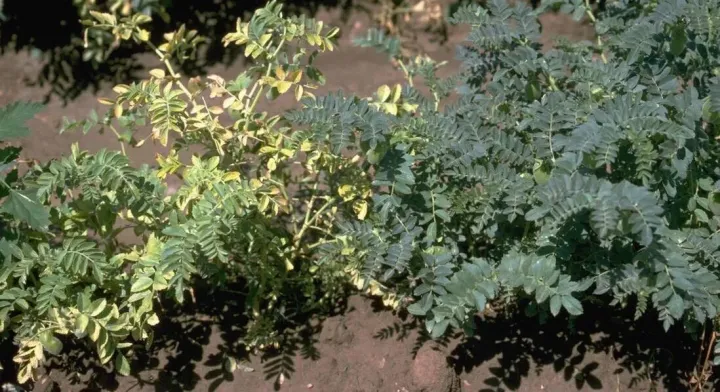
The most prominent symptom is a characteristic yellowing (chlorosis) of the foliage, starting at the top of the plant and progressively moving downwards. The leaves may eventually become brittle and turn shades of yellow or reddish-orange.
Infected plants exhibit severe stunting, appearing significantly smaller than healthy neighbors. This uneven crop development is a typical indicator of a viral patch within a field.
Key symptoms include:
- Yellowing or reddening of leaf margins.
- Severe reduction in internode length.
- Upward curling and stiffening of leaves.
- Reduced pod setting and pod deformation.
- Poor grain filling, resulting in shriveled seeds.
While chlorosis is a common sign, it is important to distinguish it from abiotic issues like nitrogen deficiency or salinity. Unlike mineral deficiencies, these viral symptoms do not respond to fertilization.
Symptom expression is heavily influenced by the plant's growth stage at the time of infection, the local aphid population density, and prevailing environmental conditions.
Control measures
The primary control strategy focuses on managing aphid populations. Systematic application of insecticides at early crop stages is crucial to prevent the initial spread of the virus from winged aphid migrants.
Spatial isolation is a vital preventative measure. Planting chickpea crops away from perennial legumes or weed reservoirs that harbor the virus during the off-season significantly reduces the risk of primary infection.
Breeding and deploying resistant or tolerant chickpea cultivars is the most sustainable approach for managing this pathogen, reducing the need for intensive chemical interventions.
Integrated Pest Management (IPM) practices, including the elimination of alternative weed hosts and strategic adjustment of sowing dates, can help avoid peak aphid migration times.
Constant monitoring of the field for aphid presence and symptoms allows for timely management decisions, ensuring that control measures are implemented before the virus reaches widespread levels within the crop.
Discussion
No discussions yet — be the first.