
Downy mildew of lettuce
Bremia lactucae
Description
How to identify
The causative agent of the disease is Bremia lactucae, an obligate parasite belonging to the kingdom Chromista, phylum Oomycota. This pathogen is a highly specialized organism that primarily infects plants of the Asteraceae family.
The mycelium of this fungus-like organism develops within the leaf tissues in the intercellular spaces, penetrating cells using specialized feeding structures called haustoria. During reproduction, sporangiophores emerge through the stomata, forming a characteristic white, downy growth.
The pathogen is highly variable, allowing it to quickly overcome the resistance of previously immune varieties. There are numerous physiological races of Bremia lactucae, which significantly complicates breeding efforts to develop resistant cultivars.
The life cycle includes the formation of sporangia, which are spread by air currents, rain splashes, or overhead irrigation. Oospores can survive in the soil or on plant debris, providing a primary source of infection for the next season.
For spore germination, free moisture (water droplets) and relatively cool conditions are required, making greenhouses and humid field periods the most favorable environments for disease outbreaks.
What it damages
The disease affects lettuce (Lactuca sativa) at all stages of development, from the emergence of the first true leaves to the marketable maturity stage. Damage is manifested by the loss of produce quality and a reduction in plant weight.
Early infection can cause seedling mortality, leading to thinning of stands and the need for replanting. Affected heads become unsuitable for sale, as tissues rapidly decay during storage and transportation.
Infection of the leaves reduces photosynthetic capacity, which stunts plant growth. Under severe infection, the pathogen can cover the entire rosette, rendering the product completely unmarketable.
In addition to direct damage, Bremia lactucae opens "gateways" for secondary bacterial infections. Soft rot caused by opportunistic pathogens often masks the underlying cause of the disease.
Economic losses are composed of fungicide application costs, discarding affected produce, and the risk of losing entire batches if phytosanitary standards are not maintained.
When it appears
The disease spreads most actively during periods of high relative humidity (above 80-90%) and moderate temperatures ranging from 10°C to 20°C. Nighttime cooling with heavy dew creates ideal conditions for sporulation.
In protected cultivation (greenhouses), the peak of the disease occurs during periods of insufficient ventilation and drastic temperature fluctuations. Condensation on leaves is a critical factor triggering an epidemic.
In open fields, outbreaks are typically observed during spring and autumn. Summer heat and low humidity often suppress the pathogen, but the threat persists throughout the summer during cloudy and rainy weather.
Signs of infestation
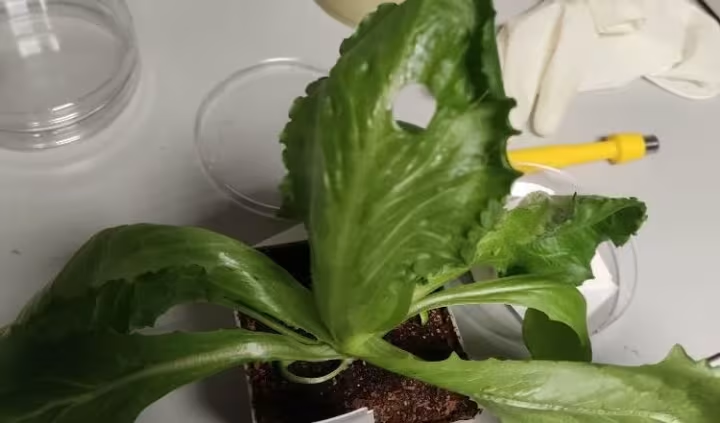
Initial symptoms appear as pale green or yellowish spots of irregular shape on the upper side of the leaf blade, typically delimited by the leaf veins.
On the underside of the leaf, in the areas corresponding to the spots, a white or grayish fluffy growth appears, consisting of the pathogen's sporangiophores. Later, the spots turn brown and dry up, becoming necrotic.
Characteristic signs of the infection include the following changes:
- Yellowing of leaf areas bounded by leaf veins.
- Appearance of a white spore growth on the underside of the leaves.
- Darkening and necrosis of affected tissues (spotting).
- Stunted growth and deformation of the leaf rosette.
- Rapid softening and decay of tissues under high humidity.
Control measures
The foundation of control is the use of resistant varieties and hybrids that possess genetic protection against the specific races of the pathogen prevalent in the region. Resistance profiles are always indicated by seed producers.
Agrotechnical measures include adhering to a crop rotation with a 2-3 year gap. It is essential to eliminate weeds of the Asteraceae family, which can serve as reservoirs for the infection during the off-season.
Optimizing the microclimate is a key protection factor. In greenhouses, avoid over-watering, ensure intense ventilation, and irrigate strictly at the base, preventing water from reaching the leaves.
Chemical control involves the application of fungicides (contact and systemic) at early stages or as a preventive measure. It is important to rotate products from different chemical groups to prevent the development of resistance in the pathogen.
Phytosanitary cleanup of the field after harvest is mandatory. All plant debris must be removed or deep-plowed into the soil to prevent the buildup of inoculum in the form of oospores.
Causes diseases · 1
Discussion
No discussions yet — be the first.